
#1 Complete & Ultimate Land Title Transfer Requirements Philippines 2026 (Easy Guide)
Purchasing real estate is widely considered the ultimate milestone for financial independence in the Philippines. Whether you are buying a condominium unit in Metro Manila, a residential lot in the province, or fully paying off a decades-long amortization, handing over the cash is only the beginning of the transaction. The most critical, high-stakes phase of acquiring real estate is navigating the complex bureaucratic gauntlet of the Land Title Transfer Requirements Philippines. Until the Transfer Certificate of Title (TCT) or Condominium Certificate of Title (CCT) legally reflects your name, you do not truly own the property in the eyes of the state.
Thousands of Filipinos fall into the dangerous trap of the “Open Deed of Sale.” Buyers often hold onto notarized documents for years without executing the formal transfer at the Registry of Deeds to save money on immediate taxes. This is a catastrophic financial mistake. In 2026, the Bureau of Internal Revenue (BIR) and local municipal assessors enforce aggressive, compounding penalty matrices for delayed registrations. A delay of even a few months can result in hundreds of thousands of pesos in surcharges, interest, and compromise penalties, effectively wiping out the investment value of your new property.
As the premier authority on Philippine legal and administrative compliance, RequirementPH has engineered this definitive, chronologically structured masterclass. We will dissect the exact Land Title Transfer Requirements Philippines for 2026. This comprehensive guide will walk you through the precise multi-agency sequence—from the initial due diligence and notarization, through the rigorous BIR tax assessments, and finally to the local Registry of Deeds to officially print your new title.
Phase 1: Pre-Transfer Due Diligence & Verification
Never sign a Deed of Absolute Sale (DOAS) or hand over a downpayment without conducting strict, uncompromising due diligence. The Philippine real estate market is unfortunately riddled with counterfeit titles, undisclosed encumbrances, and properties tangled in complex inheritance disputes. Fulfilling the pre-transfer Land Title Transfer Requirements Philippines ensures you are buying a clean, legally transferable asset.
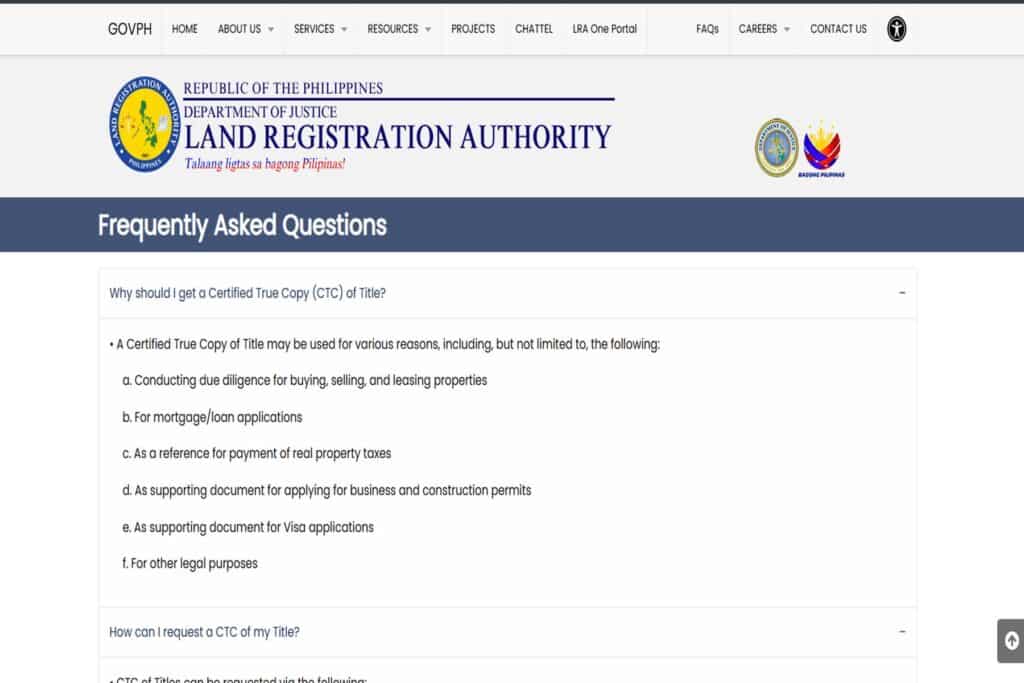
1. Securing a Certified True Copy (CTC) of the Title
Do not trust a photocopy provided by the seller or the real estate broker. You must personally visit the Registry of Deeds (ROD) that holds jurisdiction over the property’s location, or utilize the Land Registration Authority (LRA) eSerbisyo portal, to request a Certified True Copy of the title. You must verify three distinct elements:
- Registered Owner: The name on the title must perfectly match the seller’s Primary Valid IDs.
- Encumbrances (Memorandum of Encumbrances): Check the back page of the title. If the property was acquired via a Pag-IBIG Housing Loan or a commercial bank loan, there will be a mortgage annotation. This must be formally cancelled via a “Cancellation of Mortgage” document before the title can be transferred to you.
- Notices of Lis Pendens: This annotation indicates that the property is currently involved in active litigation or a court dispute. Do not proceed with the purchase if this annotation is active.
2. Tax Clearance from the Assessor’s Office
A property cannot be legally transferred if there are unpaid real property taxes (Amilyar). You must request the seller to provide a current Tax Clearance Certificate and an updated Tax Declaration from the local City or Municipal Assessor’s Office. This proves that all municipal property dues have been fully settled for the current fiscal year.
Phase 2: Execution of the Deed of Absolute Sale (DOAS)
The Deed of Absolute Sale is the central legal instrument that formally transfers ownership from the seller (vendor) to the buyer (vendee). However, a signed document is legally worthless for title transfers until it is officially notarized by a commissioned Notary Public.
1. Mandatory Identity and Civil Status Alignment
The notary public and subsequent government agencies will strictly cross-reference the civil status of both parties. If the seller is married, their spouse must absolutely sign the DOAS under the “Marital Consent” section. Selling a conjugal property without the spouse’s signature renders the sale voidable.
Both buyers and sellers must provide a unified identity profile. Ensure that you have freshly printed PSA Birth Certificates and a PSA Marriage Certificate ready. Any discrepancy in names across IDs and certificates must be fixed via a PSA Birth Certificate Correction before the DOAS is executed.
2. Notarization Prerequisites
To have the DOAS notarized, all signatories must personally appear before the Notary Public and present:
- Valid government-issued identification (e.g., DFA Passport, PRC ID, or National ID).
- Active Tax Identification Numbers (TIN). If you do not have one, you must secure it through the TIN ID Online Registration process immediately.
- A current Community Tax Certificate. You can obtain this at your local barangay or municipal hall by following the Cedula Requirements guide.
Phase 3: The BIR Gauntlet (Capital Gains Tax & DST)
The moment the Notary Public stamps and dates your Deed of Absolute Sale, a strict, uncompromising 30-day countdown begins. This is the most crucial stage of the Land Title Transfer Requirements Philippines. You must proceed to the Revenue District Office (RDO) of the Bureau of Internal Revenue (BIR) that has jurisdiction over the property’s location to settle the national transfer taxes.
1. Capital Gains Tax (CGT)
For standard residential properties classified as capital assets, the Capital Gains Tax is fixed at 6%. This 6% is calculated based on whichever is the highest among the following three figures: the Gross Selling Price stated in the DOAS, the Zonal Value set by the BIR, or the Fair Market Value stated in the municipal Tax Declaration.
Strict Deadline: You must file BIR Form 1706 and pay the CGT within thirty (30) days from the date of notarization. Missing this deadline triggers an automatic 25% surcharge, 12% annual interest, and thousands of pesos in compromise penalties.
2. Documentary Stamp Tax (DST)
The Documentary Stamp Tax is an excise tax levied on the execution of the sale, fixed at 1.5% of the highest property valuation (Selling Price, Zonal Value, or Fair Market Value). You must file BIR Form 2000-OT to process this.
Strict Deadline: The DST must be paid by the 5th day of the month following the date of notarization. This deadline is incredibly tight and catches many buyers off guard.
3. Securing the Electronic Certificate Authorizing Registration (eCAR)
After filing the forms and paying the taxes at an Authorized Agent Bank (AAB), you must surrender the deposit slips, the original notarized DOAS, the CTC of the title, and the tax clearances to the BIR. The RDO will process these documents and issue an Electronic Certificate Authorizing Registration (eCAR). The eCAR is the ultimate proof that national taxes have been paid; the Registry of Deeds will completely reject your application without it.
Phase 4: Local Treasurer’s Office (The Transfer Tax)
Once you possess the BIR eCAR, you must transition from national federal taxes to local municipal taxes. You must proceed to the Local Treasurer’s Office at the City or Municipal Hall where the real estate property is physically located.
1. Transfer Tax Computation and Deadlines
The Local Transfer Tax is charged by the LGU for transferring the ownership of real property. The rate varies depending on the municipality but generally ranges between 0.50% (for provincial properties) to 0.75% (for properties within Metro Manila) of the total property valuation.
Strict Deadline: You are legally mandated to pay the Local Transfer Tax within sixty (60) days from the date of notarization of the Deed of Absolute Sale. Present your DOAS, the BIR eCAR, and the local Tax Clearance to the municipal assessment window to have the order of payment generated.
Phase 5: The Registry of Deeds (ROD) – Printing the New Title
You have now paid all national and local taxes. It is time to execute the final legal transfer. You must proceed to the Registry of Deeds (ROD) bearing your massive dossier of collected documents to officially cancel the seller’s title and print the new certificate bearing your name.
1. The Master Documentary Checklist for the ROD
To finalize the Land Title Transfer Requirements Philippines, the ROD receiving personnel will demand the original, unblemished copies of the following documents:
- The Original Owner’s Duplicate Certificate of Title (surrendered by the seller).
- The original notarized Deed of Absolute Sale.
- The original BIR Electronic Certificate Authorizing Registration (eCAR).
- The Official Receipt of the Local Transfer Tax payment from the City Treasurer.
- The updated Real Property Tax Clearance.
- Clear photocopies of all signatories’ Government IDs, bearing their specimen signatures.
- A certified copy of the Articles of Incorporation and Secretary’s Certificate (only required if the buyer or seller is a registered corporation managing small business assets).
2. Registration Fees and Releasing
Upon submission, the ROD will assess the registration fees based on the approved LRA fee schedule. Once paid, your documents will enter the processing pipeline. The old title will be stamped “CANCELLED,” and a fresh Transfer Certificate of Title (TCT) or Condominium Certificate of Title (CCT) will be generated. Depending on the specific municipal workload, releasing the physical title can take anywhere from two weeks to several months.
Phase 6: The Assessor’s Office (Updating the Tax Declaration)
Many new homeowners mistakenly believe the process concludes when they hold the new title in their hands. There is one final, crucial step: updating the Tax Declaration. The title proves ownership, but the Tax Declaration dictates who receives the annual property tax (Amilyar) billing.
You must return to the City or Municipal Assessor’s Office and present a certified true copy of your newly issued TCT or CCT, alongside the DOAS and the BIR eCAR. The Assessor will formally cancel the old Tax Declaration under the seller’s name and issue a new one under your name. Only after this step is completed are you 100% legally recognized as the absolute owner across all federal and municipal databases.
⚠ Important Regulatory & Real Estate Compliance Notice
RequirementPH operates strictly as an independent, privately-funded educational index mapping complex public administrative workflows in the Philippines. We are NOT affiliated, associated, authorized, endorsed by, or in any way officially connected with the Land Registration Authority (LRA), the Bureau of Internal Revenue (BIR), or any specific municipal Registry of Deeds.
National tax brackets, zonal valuations, municipal transfer tax rates, and specific documentary checklists are subject to immediate legislative adjustments by local government councils and the Department of Finance. Executing property transfers involves high-stakes financial liability. It is highly recommended to consult with a licensed real estate broker or a property lawyer when executing high-value asset transfers. Always process your final commercial tax applications exclusively through verified, official `.gov.ph` portals or at physically established municipal offices. For official legal texts regarding taxation and land registration, cross-reference directly with the Bureau of Internal Revenue (BIR), the Land Registration Authority (LRA), or review updates on the Official Gazette of the Republic of the Philippines.
Strategic Resource Links for Property Owners
To ensure your financial and civil profiles are fully synchronized before executing a major real estate transaction, cross-reference your documentation with our central reference guides:
- Pag-IBIG Housing Loan Requirements Philippines (Financing Your Purchase)
- Government Loan Requirements Philippines 2026 (Securing SSS and Pag-IBIG Capital)
- Complete Civil Registry Requirements Philippines 2026 (Resolving Buyer/Seller Name Mismatches)
- Small Business Registration Requirements Philippines (For Commercial Property Acquisitions)
- Freelancer Government Registration Philippines (Proving Income for Mortgages)