
Cedula Requirements Philippines 2026 (Complete & Easy Community Tax Certificate Guide)
Securing your Community Tax Certificate (CTC), commonly known as a Cedula, might seem like a trivial government errand. However, knowing the exact Cedula Requirements Philippines 2026 is absolutely crucial. Whether you are notarizing a legal contract, registering a new business, filing your income tax returns, or finalizing your real estate documents, the Cedula acts as your fundamental proof of residency and community tax contribution.
Because the Cedula is so easy to obtain, many Filipinos assume they can just walk into any barangay hall with empty pockets. This often leads to unnecessary delays, surprise fees, and incorrectly filled-out forms. Furthermore, massive confusion still surrounds the question: “Is a Cedula still required for pre-employment?”
As your premier authority on Philippine government transactions, RequirementPH has engineered this definitive masterclass. We will not just list the Cedula Requirements Philippines 2026. We will teach you exactly how to compute your community tax based on your gross income, clarify the current employment laws surrounding it, and provide actionable solutions if you lose your certificate.
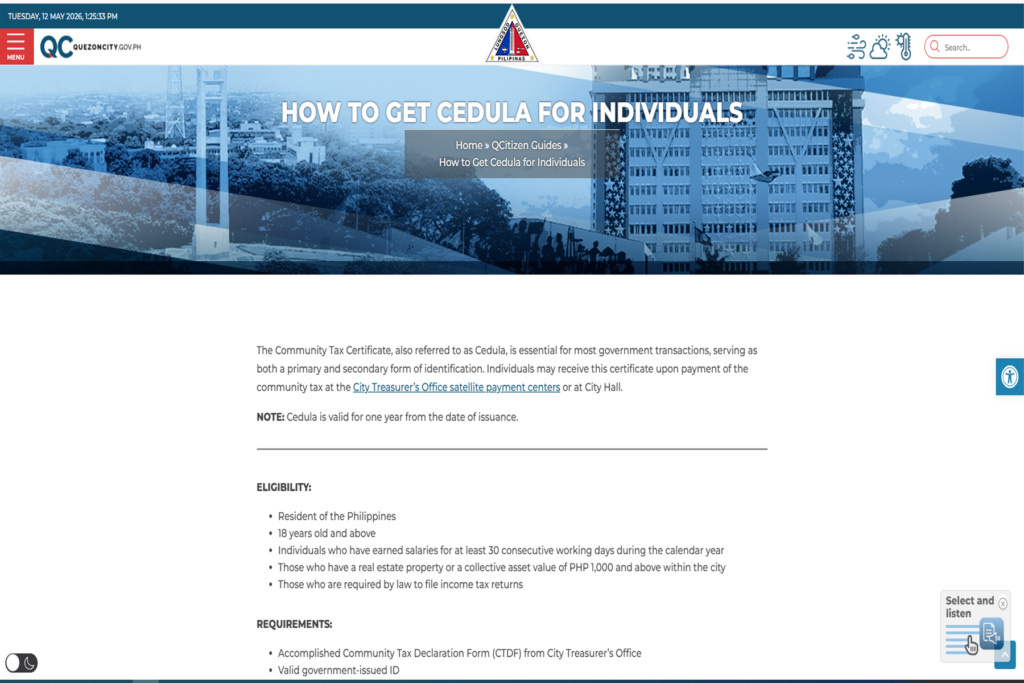
Who is Required to Get a Cedula?
Under the Local Government Code of the Philippines, the payment of the community tax and the issuance of a Cedula is mandatory for the following individuals:
- Every inhabitant of the Philippines who is eighteen (18) years of age or older.
- Individuals who have been regularly employed on a wage or salary basis for at least thirty (30) consecutive working days during any calendar year.
- Individuals engaged in business or practicing a licensed profession.
- Individuals who own real property with an assessed value of ₱1,000 or more.
Core Cedula Requirements Philippines 2026
To avoid getting sent home by your local municipal treasurer, you must physically prepare the correct Cedula Requirements Philippines 2026 documents before visiting the city hall or barangay outpost.
1. A Valid Primary or Secondary ID
You must prove your identity and your current residential address. Bring the original and a photocopy of any recognized government ID. Accepted IDs include your PhilSys National ID, Passport, Driver’s License, or Postal ID. If you don’t have one, cross-reference our ultimate guide on the Complete Valid ID Requirements in the Philippines.
2. Proof of Income (For Accurate Tax Assessment)
Your Cedula fee is not a flat rate—it depends on how much money you made in the preceding year. You must bring one of the following:
- For Employees: Your latest Payslip or BIR Form 2316 (Income Tax Return).
- For Business Owners: Your previous year’s Gross Sales Receipts or Income Tax Return (ITR).
- For Unemployed/Students: You only need to declare that you are unemployed. You will only pay the base fee.
How to Compute Your Cedula Tax (The Community Tax Formula)
One of the biggest reasons people get overcharged is that they don’t know how the tax is calculated. A crucial part of mastering the Cedula Requirements Philippines 2026 is understanding the math. Under the law, your Community Tax is composed of a Basic Tax and an Additional Tax.
| Category | Tax Formula Breakdown |
|---|---|
| Basic Tax | A flat rate of ₱5.00 for all eligible individuals. |
| Additional Tax (Income) | ₱1.00 for every ₱1,000 of your gross earnings from the preceding year. |
| Additional Tax (Property) | ₱1.00 for every ₱1,000 of the assessed value of your real property. |
| Maximum Cap | The total Community Tax cannot exceed ₱5,000.00. |
Example Computation:
If you earned a gross salary of ₱300,000 last year:
Basic Tax = ₱5.00
Additional Tax = (₱300,000 / 1,000) x 1 = ₱300.00
Total Cedula Fee = ₱305.00
Where to Apply for Your Cedula in 2026
Once your Cedula Requirements Philippines 2026 are ready, you can proceed to the designated government offices. Unlike national IDs, Cedulas are issued locally.
- The City or Municipal Treasurer’s Office: This is the primary issuing authority located inside your local City Hall.
- Your Local Barangay Hall: Most City Treasurers deputize Barangay Captains to issue CTCs to make it accessible. This is the fastest route, though some barangays only issue basic (unemployed) Cedulas.
Simply present your ID and proof of income, fill out the Community Tax Declaration Form (CTDF), pay the computed amount, and the officer will ink your thumbprint directly onto the certificate.
Is the Cedula Still Required for Employment? (Legal Clarification)
This is the most frequently asked question regarding the Cedula Requirements Philippines 2026. For decades, a Cedula was a non-negotiable pre-employment requirement.
However, thanks to the First Time Jobseekers Assistance Act (Republic Act No. 11261) and modern HR streamlining, most private corporations no longer require a Cedula for hiring. Modern employers heavily prioritize your TIN, SSS, PhilHealth, and Pag-IBIG numbers over a community tax certificate.
If you are a fresh graduate, we highly recommend focusing your energy on our comprehensive First Time Job Requirements Philippines 2026 checklist rather than stressing over a Cedula.
When IS it still required? You will strictly need a Cedula if you are applying for a government job (Civil Service), opening specific corporate bank accounts, registering a small business, or having an affidavit notarized by a lawyer.
Troubleshooting: What if I lose my Cedula?
Unlike a plastic National ID or Passport, a Cedula is printed on thin, fragile paper. If you accidentally lose or destroy your CTC, there is no “reprinting” or “replacement” process.
Because it is simply a tax receipt, the only solution to a lost Cedula is to gather your Cedula Requirements Philippines 2026 again, go back to the City Hall or Barangay, and apply for a brand-new one. You will have to pay the computed tax fee a second time. This is why we strongly advise keeping multiple photocopies of your Cedula the moment it is issued to you.
⚠ Important Legal Disclaimer
RequirementPH is an independent, privately-funded educational platform dedicated to streamlining bureaucratic processes like the Cedula Requirements Philippines 2026. We are NOT affiliated, associated, authorized, endorsed by, or in any way officially connected with the Department of the Interior and Local Government (DILG), or any specific City or Municipal Treasurer’s Office.
While we research diligently to provide accurate tax computation guides, exact processing fees, local tax ordinances, and penalty deadlines for late CTC payments vary significantly by Local Government Unit (LGU). Always transact directly inside official government premises and avoid “fixers” loitering outside municipal halls. For official texts regarding the Local Government Code, cross-reference with the Official Gazette of the Republic of the Philippines.