SSS Contribution Table 2026 (Official Updated Rates & Complete Guide)

Complete & Ultimate SSS Contribution Table 2026 (Official Updated Rates & Guide)

If you are a working professional, a business owner, or a freelancer in the Philippines, staying updated with the official SSS Contribution Table 2026 is not just a recommendation—it is an absolute financial necessity. The Social Security System (SSS) is the bedrock of the Filipino worker’s safety net, providing critical financial support during sickness, maternity, disability, and retirement.

However, your monthly premium rates do not stay the same forever. Following the strict implementation of Republic Act No. 11199, also known as the Social Security Act of 2018, the contribution rates have steadily increased to ensure the long-term viability of the national pension fund.

In 2026, the Philippine government officially reaches its mandated 15% contribution rate threshold. This increase comes alongside significant adjustments to the Minimum and Maximum Monthly Salary Credits (MSC), which directly impact your take-home pay and your eventual retirement benefits.

Many Filipinos make the dangerous mistake of ignoring these rate changes until a financial emergency strikes. Imagine applying for a critical salary loan or a life-saving maternity benefit, only to discover that your application is rejected because your contributions fell short of the newly updated sss bracket 2026.

Whether you are an HR manager calculating payroll deductions, a Voluntary Member planning your pension, or an OFW securing your family’s future back home, this ultimate masterclass will break down everything you need to know. We will explain exactly how much you need to pay, how the mandatory WISP provident fund works, and how to avoid costly payment scams.

SSS Contribution Table 2026 Business Employers

Phase 1: Understanding the New 15% Contribution Rate

Why do your premiums keep going up? It is a question millions of Filipinos ask when they review their monthly payslips. The reality is that as the cost of living and healthcare rises, the SSS needs a significantly larger fund pool to fulfill its promised pension payouts to millions of retirees.

Under the law, the total SSS contribution rate for 2026 is officially set at 15% of a member’s declared Monthly Salary Credit (MSC). For formally employed individuals, this heavy financial burden is not shouldered alone.

The total premium is legally split between the employer and the employee to ensure the everyday worker is not overwhelmed by the tax deduction. This sharing formula is strictly monitored by the Department of Labor and Employment (DOLE).

  • Employer Share: 10.5%
  • Employee Share: 4.5%
  • Total Contribution: 15%

Additionally, the Minimum MSC for regular employees is set to ₱4,000 (though different minimums apply to OFWs and Kasambahays). Conversely, the Maximum MSC is capped at ₱30,000. Understanding these baseline numbers is crucial as you navigate the specific employment categories outlined below.

Phase 2: SSS Contribution Table 2026 for Regular Employees and Employers

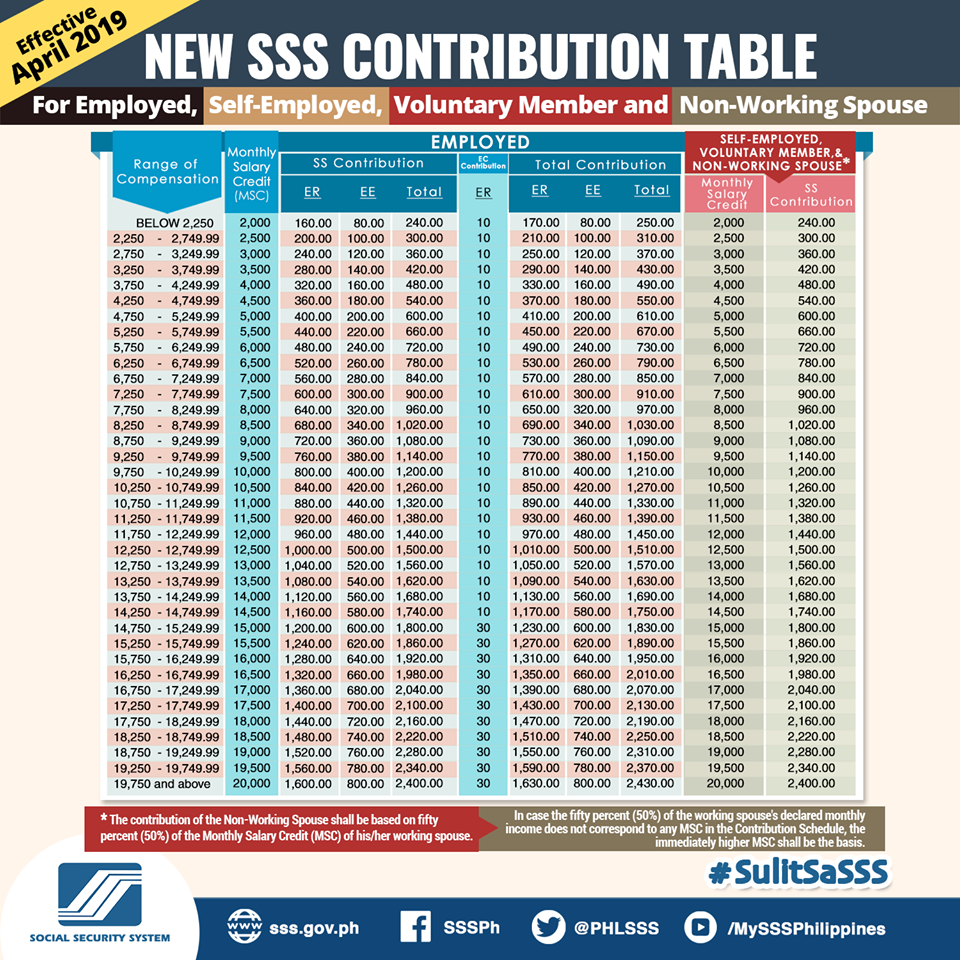
If you work for a private company, a retail shop, or any registered commercial entity, you fall under the Employed category. Your Human Resources and Accounting departments will use the specific SSS Contribution Table 2026 schedule to calculate your monthly payroll deductions.

It is highly recommended that you monitor this computation yourself to ensure accurate remittances. Ignorance of your own deductions can lead to severe benefit rejections in the future.

SSS Contribution Table 2026 Employees Share Breakdown

1. The Employer’s Exclusive EC Fund Liability

Aside from the standard 15% rate, employers are exclusively mandated to pay the Employees’ Compensation (EC) Fund. This is an extra ₱10 for workers earning an MSC of ₱14,500 and below, or ₱30 for workers earning an MSC of ₱15,000 and above.

The EC Fund provides additional financial benefits if an employee suffers from work-related sickness, severe injury, or death. The employee does not contribute a single peso to the EC fund; it is solely the corporate employer’s legal responsibility.

2. Real-World Computation (Example Scenario)

To fully grasp the updated sss table 2026, let us look at a realistic salary computation. If your declared monthly salary is ₱20,000, your MSC falls exactly into the ₱20,000 bracket.

The total 15% contribution based on the 2026 mandate is ₱3,000. Your personal salary deduction (the 4.5% share) will be ₱900. Meanwhile, your employer’s share (the 10.5% portion) will be ₱2,100.

When you factor in the Employer’s EC Fund addition of ₱30, the absolute total remitted to the SSS under your name is ₱3,030. If your employer deducts the ₱900 from your payslip but fails to remit the full ₱3,030 to the SSS, they are committing a serious criminal offense known as Estafa.

Phase 3: SSS Contribution Table 2026 for Self-Employed and Freelancers

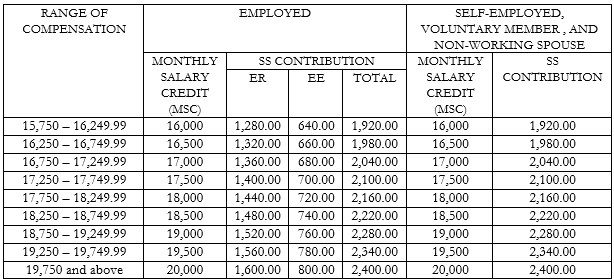
With the gig economy booming in the Philippines, millions of freelancers, online sellers, digital nomads, and independent contractors fall under the Self-Employed category. For this rapidly growing demographic, the SSS Contribution Table 2026 works a bit differently.

SSS Contribution Table 2026 Range Compensation

1. Shouldering the Full 15% Burden

Because you do not have a corporate employer to subsidize the 10.5% share, you must shoulder the entire 15% yourself to keep your federal benefits active. This is the trade-off for professional independence.

For example, if you are a Self-Employed graphic designer and you declare an income of ₱10,000 (MSC), you must pay the full 15% (₱1,500) out of your own pocket. You must also add the mandatory EC fund (₱10), bringing your total monthly payment to ₱1,510.

2. Strategic Advice for Freelancers

Do not make the mistake of declaring the absolute minimum (₱4,000 MSC) just to save cash, especially if you are earning well. Your eventual retirement pension, your maternity benefits, and your loanable cash amounts are directly tied to your declared MSC.

Paying a higher premium now means a much larger cash benefit when you execute your SSS Retirement Requirements Philippines later in life. In the world of social security, long-term consistency matters significantly more than short-term savings.

Phase 4: Voluntary Members and Non-Working Spouses

If you were previously employed but are currently taking a career break, or if you are a stay-at-home parent, you must not let your SSS account go dormant. You can instantly transition your status to a Voluntary Member.

1. Voluntary Membership Rules

Voluntary members follow the exact same 15% rate as self-employed individuals, but they are completely exempt from paying the additional EC fund. Maintaining active voluntary payments is absolutely crucial for mothers planning their family.

If you become pregnant, you must have at least three (3) posted monthly contributions within the 12-month period before your semester of childbirth to qualify for state funding. You can review this exact pipeline in our SSS Maternity Benefit Requirements Philippines master guide.

2. Non-Working Spouse Protections

A non-working spouse is legally entitled to build their own independent pension fund. Your contribution bracket is legally determined by the income of your working spouse.

You will pay the 15% rate based exactly on 50% of your working spouse’s declared Monthly Salary Credit. This brilliant legal provision ensures that stay-at-home partners are financially protected and empowered during their senior retirement years.

Phase 5: SSS Contribution Table 2026 for OFWs and Kasambahays

The Philippine government mandates strict financial protections for specific labor sectors. Overseas Filipino Workers (OFWs) and domestic helpers (Kasambahays) have unique rules tailored to their earning environments.

Comprehensive SSS Contribution Table 2026 Detailed Breakdown

1. The Strict Rules for OFWs

The government recognizes that OFWs earn in foreign currency and generally have higher earning capacities. Therefore, the baseline metrics on the SSS Contribution Table 2026 for OFWs are adjusted to secure them a higher pension upon returning home.

While regular local workers have a minimum MSC of ₱4,000, the absolute minimum for Land-Based OFWs is set at ₱8,000. Sea-Based OFWs are treated similarly to regular employed members, where their manning agency acts as the employer shouldering the 10.5% share.

Land-Based OFWs must remit the full 15% themselves, either through the sss app, partnered international remittance centers abroad, or online banking platforms.

2. The Kasambahay Law (RA 10361)

Under the Kasambahay Law, domestic workers (maids, drivers, gardeners, yaya) are entitled to full social protection. If you employ a Kasambahay, you must strictly follow their specific payment brackets.

If your Kasambahay earns less than ₱5,000 a month, the employer is legally obligated to pay the entire 15% contribution without deducting anything from the worker’s salary. If they earn ₱5,000 and above, the standard split (10.5% employer / 4.5% employee) applies.

Phase 6: The Mandatory WISP (Workers’ Investment and Savings Program)

One of the most confusing aspects of the new rate adjustments is the WISP. Many members notice that their SSS deductions suddenly spiked, and a portion is being actively diverted to a mysterious “Provident Fund.”

WISP is a mandatory provident fund program introduced alongside the RA 11199 changes. It acts as an additional layer of savings on top of the regular SSS pension, designed specifically to combat hyper-inflation and give retirees a more substantial lump sum.

1. How WISP Computations Work

The regular SSS pension fund only covers up to an MSC of ₱20,000. If you declare an MSC higher than ₱20,000 (up to the maximum of ₱30,000), any amount exceeding the ₱20,000 mark is automatically channeled into your WISP account.

WISP contributions earn highly competitive, tax-free investments and dividends managed by the state. When you finally retire, you will receive your regular monthly pension PLUS the accumulated WISP savings, either as a massive lump sum or added to your monthly payout.

Phase 7: Step-by-Step Guide on How to Pay SSS Contributions Online

You no longer need to endure long, exhausting lines at the physical SSS branches to settle your monthly premiums. The state has fully modernized its payment gateways, making it incredibly easy to pay your dues using the sss login portal.

1. Generating Your Payment Reference Number (PRN)

You cannot simply walk into a Bayad Center with cash and your SSS number anymore. You must generate a Payment Reference Number (PRN) first. The PRN is a unique alphanumeric code that tells the SSS system exactly which month and which MSC bracket you are paying for.

Execute your my sss login via the official website or the SSS Mobile App. Click on the “Generate PRN” tab, select your membership type, and choose the applicable period. Select your premium based on the updated sss bracket 2026 and click generate.

2. Using GCash, Maya, and Digital Banking

Once you have your active PRN, you can pay instantly using popular e-wallets like GCash or Maya. Simply open your e-wallet app, go to “Pay Bills,” and select “Government.” Choose SSS, input the exact PRN, and confirm the payment.

Alternatively, you can pay via the mobile apps of major partner banks. The payment is posted in real-time to the SSS database, ensuring your eligibility for an SSS Salary Loan remains perfectly intact.

Phase 8: Leveraging the SSS Pension Calculator

Every contribution you make today directly impacts the quality of your life tomorrow. To visualize your future financial standing, you must utilize the official sss pension calculator available inside your member portal.

The sss pension calculator uses a complex algorithm that factors in your total Credited Years of Service (CYS) and your Average Monthly Salary Credit (AMSC). It automatically selects the highest possible computation among three different legal formulas to guarantee you the maximum payout.

By consistently paying the maximum sss bracket 2026, you force the calculator to generate a significantly higher projected monthly pension. This is why financial advisors strongly recommend upgrading your MSC whenever your income increases.

Frequently Asked Questions (FAQs)

To further clarify the updated financial guidelines, we have compiled the most frequently asked questions surrounding the sss table 2026 based on recent inquiries from Filipino workers.

Where can I download the official SSS Contribution Table 2026 PDF?

You can download the high-resolution sss contribution table 2026 pdf directly from the “Downloadable Forms” section of the official SSS website (sss.gov.ph). It is highly recommended to save a copy on your smartphone for quick reference when auditing your payslips.

How do I execute my SSS Online Registration?

If you do not have an account yet, you must complete your sss online registration via the member portal. You will need your SS Number, a valid email address, and a trusted mobile number. Activating this account allows you to track all your posted premiums electronically.

Can I change my bracket if my income suddenly decreases?

Yes. If you are a self-employed or voluntary member, you have the flexibility to lower or increase your Monthly Salary Credit depending on your current financial capacity. You simply need to generate a new PRN reflecting your newly chosen bracket.

What happens if I miss a monthly contribution?

For voluntary and self-employed members, the SSS strictly prohibits retroactive payments. If you miss the payment deadline for January, you can no longer pay for January once February begins. Missing payments will lower your total Credited Years of Service.

How do I track my overall SSS benefits?

You can easily track all your sss benefits by utilizing the official sss app on your mobile device. The app provides real-time notifications regarding your loan approvals, maternity claims, and dividend earnings from your WISP portfolio.

WARNING: Beware of “Adjusted Rate” Fixers and Fake Centers

As the premium rates have increased over the years, a massive scam has flooded Facebook groups and online forums. Syndicates offer to “hack” the SSS Contribution Table 2026 and give you a “discounted” premium rate for a small processing fee.

This is 100% fraudulent. Do not engage with them under any circumstances.

The SSS contribution rates are hard-coded into the national database by law. No fixer can lower your premium. What these scammers do is take your money, edit a fake payment receipt using Photoshop, and disappear into the digital ether.

When you check your My.SSS account months later, you will see absolutely zero posted payments, rendering you completely ineligible for critical salary loans or sickness allowances. Always generate your own PRN and pay only through officially accredited channels.

Important Financial & Regulatory Notice

RequirementPH is a privately owned and operated educational platform designed to simplify government transactions for everyday Filipinos. We are NOT affiliated, associated, authorized, endorsed by, or in any way officially connected with the Philippine Social Security System (SSS) or any government entity.

While we research tirelessly to provide the most accurate breakdown of the SSS Contribution Table 2026, specific MSC brackets, WISP allocations, and penalty rules are subject to immediate adjustments by the Social Security Commission (SSC).

Evading mandatory SSS remittances as an employer is a severe criminal offense punishable by lengthy imprisonment and massive financial penalties. Always execute your official payments exclusively through verified `.gov.ph` digital portals or authorized banking partners.

For official legal texts regarding the Social Security Act of 2018 (RA 11199) and exact actuarial computations, verify directly with the Social Security System (SSS) and cross-reference with the Official Gazette of the Republic of the Philippines.

Your Next Steps & Related Guides

Now that you understand your monthly contributions based on the updated matrix, ensure your actual SSS account is fully active and verified to avoid delays when applying for a loan or a new job. Check out our related government guides to keep your portfolio complete:

About the Author:
The RequirementPH Editorial Team focuses on simplifying Philippine government processes into easy-to-follow, high-quality guides for all Filipinos.

Leave a Comment

Your email address will not be published. Required fields are marked *

Scroll to Top