
#1 Complete & Ultimate Government Pension Requirements Philippines 2026 (Easy Guide)
Reaching the age of retirement in the Philippines should be a time of relaxation and financial security. You have spent decades contributing to the national workforce, diligently paying into your mandatory state funds. However, transitioning from an active contributor to a monthly pensioner is not an automatic process. The Philippine government requires strict, unyielding documentary proof before releasing a single peso of your accumulated retirement funds.
In 2026, the Social Security System (SSS) and the Government Service Insurance System (GSIS) have fully transitioned to digitized, biometric disbursement networks. The days of receiving a physical pension check in the mail are permanently over. Today, if your underlying civil registry documents contain typographical errors, or if your banking records do not perfectly match your state ID profiles, your pension application will be automatically rejected by the system’s matching algorithms.
As the definitive authority on Philippine regulatory and financial compliance, RequirementPH has constructed this complete, stress-free retirement masterclass. We will dissect the exact, chronological Government Pension Requirements Philippines 2026. You will learn how to audit your contributions, secure your lifetime healthcare coverage, claim your Senior Citizen privileges, and ensure your identity profile is flawless so your monthly pension flows directly into your bank account without bureaucratic delays.
Phase 1: The Civil Registry & Identity Audit (Do This at Age 55)
Do not wait until your 60th birthday to check your records. State evaluators will rigorously cross-reference your entire life’s documentation to prevent pension fraud. If you wait until you retire to fix a misspelled name, you could spend the first two years of your retirement fighting legal battles instead of receiving your money.
1. The Birth Certificate Baseline
Your exact date of birth dictates your eligibility for optional (age 60) and mandatory (age 65) retirement. You must secure a freshly authenticated PSA Birth Certificate. If the year or month of birth on your SSS/GSIS portal does not perfectly match your PSA record, your pension is frozen. If you discover a discrepancy, you must immediately file a PSA Birth Certificate Correction through your Local Civil Registrar.
2. Marriage and Dependent Verification
Your pension does not only cover you; it dictates the survivorship rights of your spouse and minor children. Female retirees who changed their surnames must present a verified PSA Marriage Certificate to link their maiden employment records to their current identity. Maintaining a unified civil record is outlined deeply in our Complete Civil Registry Requirements Philippines framework.
3. Upgrading to Apex Valid IDs
To open a pension disbursement bank account, legacy paper IDs are no longer accepted. You must hold at least one highly secure, biometric credential. We strongly advise securing a National ID (PhilSys) or renewing your DFA Passport well before retirement. For alternative options, consult the Complete Government ID Requirements Philippines index.
Phase 2: Private Sector & Freelance Retirement (The SSS Pension)
For individuals who spent their careers in private corporations, working as independent registered freelancers, or serving as Overseas Filipino Workers (OFWs), the Social Security System (SSS) is your primary retirement vehicle.
1. The 120-Month Rule & Contribution Checking
To qualify for a lifetime monthly pension rather than a lump-sum refund, you must have paid a minimum of 120 monthly contributions prior to the semester of your retirement. Use the SSS Online Login Philippines portal to audit your actual posted premiums. Compare your historical payments against the modern SSS Contribution Table 2026 to ensure previous employers did not skip your remittances.
2. Executing the Pension Application
Once you hit the qualifying age and contribution threshold, you must formally apply for your benefits. The paperwork is meticulous, requiring certified true copies of your bank passbooks, separation papers from your last employer, and your SSS UMID Card. For the exact, step-by-step application pipeline, you must thoroughly study our dedicated SSS Retirement Requirements Philippines guide.
3. DAEM and Disbursement Mechanics
Your pension will only be released through a PESONet-participating bank. You must enroll your individual savings account through the Disbursement Account Enrollment Module (DAEM) inside your My.SSS portal. To understand how your final monthly payout is calculated based on your Credited Years of Service (CYS), review our comprehensive SSS Pension Requirements Philippines breakdown.
Phase 3: Public Sector Retirement (The GSIS Pension)
If you dedicated your career to public service—whether as a public school teacher, a municipal clerk, or a national agency director—your retirement is governed by the Government Service Insurance System (GSIS). Public sector pensions are notably more complex but historically offer higher monthly yields based on your Average Monthly Compensation (AMC).
1. The 15-Year Minimum Service Rule
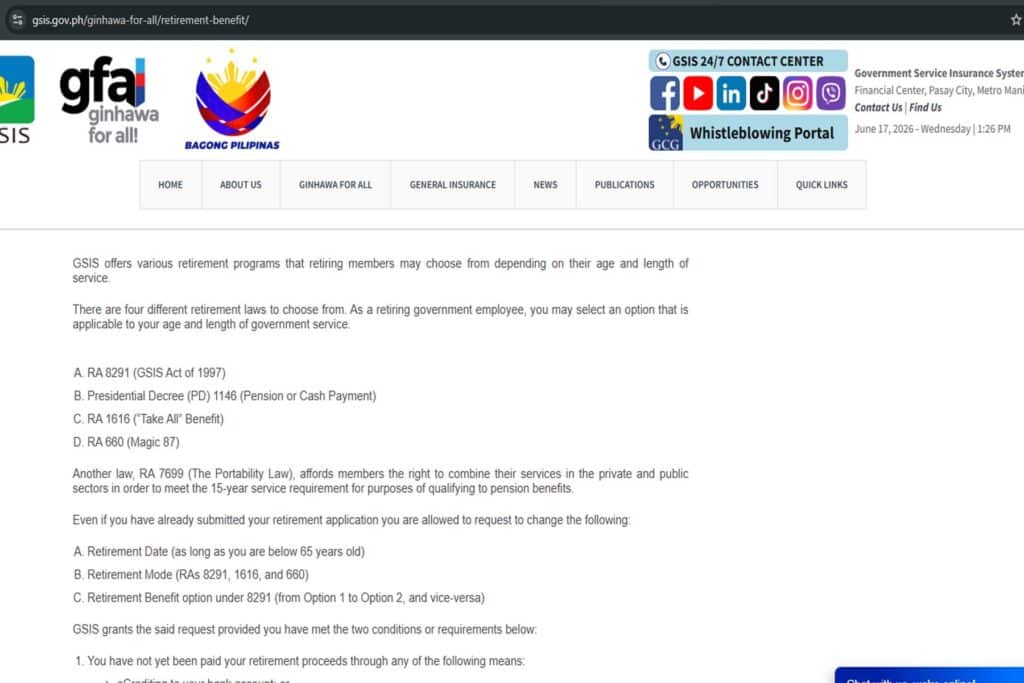
To qualify for the lifetime monthly GSIS pension under Republic Act 8291, a government employee must have rendered at least 15 years of active service and be at least 60 years old upon separation. It is critical to ensure that your initial entry into the government, likely secured through your Civil Service Exam Eligibility, is accurately timestamped in your Service Record.
2. The GSIS eCard / UMID Requirement
The GSIS issues specialized biometric cards that serve as both your federal identity and your LandBank/UnionBank ATM disbursement channel. You cannot process a retirement claim without an active, updated eCard. Ensure your biometric data is current by following our GSIS UMID eCard Requirements guide.
Phase 4: Lifetime Healthcare Security (The PhilHealth Transition)
Retirement often brings increased medical vulnerabilities. Losing your corporate health insurance can be terrifying, but Philippine law protects the elderly through the PhilHealth Lifetime Member Program.
1. Activating Lifetime Membership
If you are 60 years old and have contributed to PhilHealth for at least 120 months during your working years, you are exempt from paying any future monthly premiums. However, this is not automatic. You must visit a local branch to update your status from “Employed” to “Lifetime Member.”
You can verify your existing contribution history by utilizing the PhilHealth Online Registration portal. Once your Lifetime status is approved, generate and laminate a fresh PhilHealth MDR Form, which serves as your ultimate proof of free coverage when admitted to any accredited hospital.
Phase 5: Daily Financial Privileges (The OSCA Senior Citizen ID)
While your SSS and GSIS pensions cover your macroeconomic survival, your day-to-day microeconomic relief comes from the Office of the Senior Citizens Affairs (OSCA). The Senior Citizen ID is arguably the most powerful discount card in the republic.
- The 20% Discount & VAT Exemption: Mandated by law, this applies to restaurants, domestic flights, public transportation, and essential maintenance medications.
- The Expanded Centenarians Act: In 2026, the government actively distributes ₱10,000 cash gifts to registered seniors upon reaching the milestone ages of 80, 85, 90, and 95.
- Application Protocol: Do not delay your application. The moment you turn 60, gather your barangay clearances and birth records, and strictly follow our Senior Citizen ID Requirements Philippines master guide to secure your PVC card and purchase booklets.
Phase 6: Survivorship & Estate Preparations (Protecting Your Family)
A comprehensive retirement plan must include provisions for what happens when the pensioner passes away. In the Philippines, the surviving spouse and minor children are legally entitled to a survivorship pension and funeral grants, provided the documentation is flawless.
The entire survivorship claim rests on the immediate securing of a registered death record. The surviving family must notify the SSS or GSIS immediately to prevent the overpayment of the primary pension (which is considered fraud if withdrawn after death). The family must consult our Death Certificate Requirements Philippines guide to legally report the passing to the Local Civil Registrar before any secondary pension lines can be activated.
⚠ Important Regulatory & Financial Notice
RequirementPH operates strictly as an independent, privately-funded educational index designed to map complex public administrative workflows in the Philippines. We are NOT affiliated, associated, authorized, endorsed by, or in any way officially connected with the Social Security System (SSS), the Government Service Insurance System (GSIS), or the Philippine Health Insurance Corporation (PhilHealth).
Pension computation formulas, minimum contribution thresholds, and disbursement schedules are subject to immediate legislative adjustments by their respective corporate boards. Never rely on third-party “fixers” offering to expedite your retirement claim in exchange for a percentage of your lump sum; this is illegal and highly dangerous. Always process your final financial applications exclusively through verified, official `.gov.ph` portals or physically verified branch offices. For official legal texts regarding retirement laws and social welfare acts, cross-reference directly with the Social Security System and the Official Gazette of the Republic of the Philippines.
Strategic Resource Links for Retirees
To seamlessly navigate your upcoming pension applications and finalize your demographic profile, cross-reference your documentation with our central pillar guides: