
#1 Ultimate First Time Job Requirements Philippines 2026 (Complete Fresh Graduate Guide)
You did it. After months of polishing your resume, battling through grueling panel interviews, and anxiously checking your email inbox, you finally received the golden ticket: a formal Job Offer. You signed the employment contract, shook hands with the HR manager, and celebrated the milestone with your family. However, before you can sit at your new office desk, start remote onboarding, or earn your very first paycheck, you must survive the final, most exhausting hurdle of the hiring process: pre-employment corporate onboarding.
For a fresh graduate or first-time jobseeker, compiling a massive stack of pre-employment documents feels like navigating a frustrating bureaucratic maze. The HR department will hand you an onboarding checklist packed with acronyms—SSS, TIN, PhilHealth, Pag-IBIG, NBI, PEME—and give you a tight deadline of one or two weeks to submit everything. If you fail to submit these documents on time, your employment contract can be legally delayed or your job offer revoked before your official start date.
Do not panic. According to the master file REQUIREMENTS PH, your definitive authority on Philippine government transactions, navigating this maze is completely manageable if you know the exact steps. We have built this foolproof, comprehensive masterclass guide. We will break down the exact First Time Job Requirements Philippines 2026 checklist, teach you how to legally bypass government fees under Republic Act No. 11261, explain the exact purpose of every single document, and provide a strategic step-by-step roadmap to complete your entire pre-employment folder without stress.
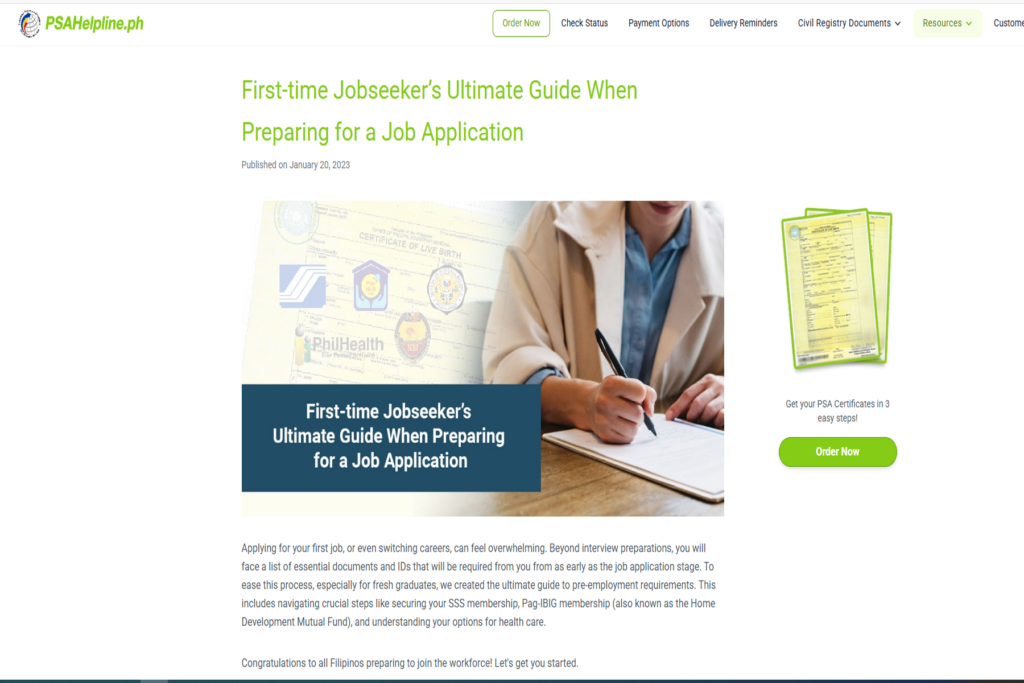
The Golden Ticket: First Time Jobseekers Assistance Act (RA 11261)
Before you step foot outside your house or spend your limited allowance on application fees, you must understand your statutory rights under Republic Act No. 11261, officially known as the First Time Jobseekers Assistance Act. Enacted into law to alleviate the financial burden on fresh college graduates, senior high school graduates, TVET graduates, and out-of-school youth, this law mandates that government agencies waive all application fees for essential pre-employment documents.
How to Avail of Free Government Documents:
- Visit Your Barangay Hall: Go to the Barangay Hall where you have permanently resided for at least six (6) months.
- Request a First Time Jobseeker Certificate: Inform the clerk that you are applying for a Barangay Certification for First Time Jobseekers under RA 11261.
- Sign the Oath of Undertaking: You will be asked to sign an official Oath of Undertaking, legally swearing that you are a first-time jobseeker actively looking for employment and that you have not previously availed of the benefit.
- Claim Your Free Certificate: The Barangay Chairman or authorized administrator will issue your official First Time Jobseeker Certification completely FREE OF CHARGE.
Pro Tip for Fresh Grads: Make at least 5 to 10 clear photocopies of this Barangay Certification. You must present the original copy and submit a photocopy to every government agency counter you visit. Under the law, presenting this certificate waives the application fees for your Barangay Clearance, Police Clearance, NBI Clearance, Medical Certificate from a public hospital, and your official PSA Birth Certificate!
Phase 1: Foundational Identification & Security Clearances
Every legitimate employer in the Philippines is required by law to verify your legal identity, citizenship, and background to ensure you have no active criminal liabilities. These background documents are the primary First Time Job Requirements Philippines 2026 you should process immediately, as some carry processing lead times.
1. PSA Birth Certificate & Valid IDs
Your birth record is the ultimate baseline proof of your identity, age, and citizenship. HR departments strictly require a clear psa birth certificate philippines copy printed on official Security Paper (SECPA) to register your employee profile in their master system. Every applicant must present a valid birth certificate.
You have multiple ways to secure this document. You can book a walk-in appointment, or you can order a psa birth certificate online. If you want to skip the lines, simply request an online psa birth certificate through official channels. By utilizing the online birth certificate psa portal, delivery is remarkably fast. Whether you use the birth certificate online psa ordering system or go to an SM Business Center, the result is the same. To obtain the certificate, birth certificate request forms must be filled out accurately.
Important Note: When you receive your official psa birth certificate, double-check all entries. If there are typos on your birth certificate, birth certificate correction procedures under RA 9048 must be filed at the Local Civil Registry. Also, if you use the psa philippines online services, remember that you cannot use the RA 11261 free waiver for online courier deliveries; the free waiver only applies to walk-in PSA CRS outlets.
To support your birth document, employers will ask for a primary government id. The national id is the most powerful identifier. The philippine national identity card (commonly referred to as the philippine national id) is accepted universally. Note that the government has replaced the old national id online registration system. Today, national id registration online appointment is no longer needed; it is purely a walk-in biometrics process. If you do not have this ID yet, you might want to review the latest dfa passport requirements to secure a passport as a robust alternative.
2. NBI Clearance
The National Bureau of Investigation (NBI) Clearance proves that you have no active criminal cases, court convictions, or pending arrest warrants anywhere in the Philippines.
- How to Secure: Register an account on the official NBI Clearance Online Portal.
- Waiving the Fee: During account setup, check the box indicating you are a First Time Jobseeker. The system will automatically waive the ₱160.00 processing fee!
- Handling a HIT: If your name yields a “HIT” (meaning someone with a similar name has a court record), the NBI officer will ask you to return after 8 to 12 working days for manual verification. Process this clearance early to prevent onboarding delays.
3. National Police Clearance & Barangay Clearance
While an NBI clearance checks national court records, securing a police clearance is also mandated by employers—especially in banking, finance, healthcare, and BPO sectors—to conduct local security verification.
- Barangay Clearance: Issued directly at your local Barangay Hall upon presenting your valid ID. Free of charge under RA 11261.
- National Police Clearance: You must complete your police clearance online registration via the official National Police Clearance System (NPCS). Select the “First Time Jobseeker” option to waive the ₱150.00 fee, choose your preferred local police station, and book your police clearance online appointment. After your photo and biometrics capture, you will receive your printed national police clearance certificate instantly.
Phase 2: The Mandatory Government Contributions (“Big 4”)
The Philippine Labor Code mandates that every formally employed worker in the private or public sector must be registered under four major government institutions. Without these permanent identification numbers, your company cannot legally compute your payroll, remit tax withholdings, or credit your government benefits.
1. Tax Identification Number (TIN) – BIR
Your Tax Identification Number (TIN) tracks your income tax withholdings under the Bureau of Internal Revenue (BIR). Generating a TIN is completely free.
- Company Registration (BIR Form 1902): Most HR departments prefer to generate TINs for first-time jobseekers in bulk. HR will provide you with BIR Form 1902 (Application for Registration for Individuals Earning Purely Compensation Income). You fill out the form, attach a copy of your birth certificate and ID, and return it to HR to process at their designated Revenue District Office (RDO).
- Online Registration (BIR ORUS): If your employer requires you to secure a TIN independently, you can register directly through the BIR ORUS (Online Registration and Update System) portal.
2. Social Security System (SSS) Number
Your SSS number registers you with the private sector social safety net, unlocking sickness benefits, maternity/paternity leave allowances, disability coverage, salary loans, and retirement pensions.
- Online SSS Registration: Log into the official My.SSS Portal and use the sss online registration facility by clicking “Apply for an SS Number Online.”
- Process: Fill out your biographical details, submit your email address, and upload a copy of your basic documents. Your my sss account will be activated immediately.
- E-1 Form: The system will issue a permanent 10-digit SSS number and generate your downloadable SSS E-1 Personal Record Form. Print this form and submit it to HR. Keep your account active, as you will need it if you ever plan on applying for an sss loan in the future.
3. PhilHealth Member Identification Number (PIN)
PhilHealth provides universal state health insurance, discounting hospital bills, room accommodations, and surgeries for you and your legal dependents.
- Registration Steps: Visit a Local Health Insurance Office (LHIO) or complete your application online via the PhilHealth Portal.
- Required Documents: Submit a completed PhilHealth Member Registration Form (PMRF), two 1×1 ID pictures, and a copy of your PSA birth certificate.
- Member Data Record (MDR): Upon registration, PhilHealth will issue your permanent 12-digit PIN and print your official Member Data Record (MDR). Submit a copy of your MDR to HR.
4. Pag-IBIG (HDMF) MID Number
The Home Development Mutual Fund (Pag-IBIG) acts as the government’s mandatory savings program and affordable housing loan provider.
- Registration Steps: Access the Virtual Pag-IBIG Portal online registration gateway.
- Filling Out the MDF: Start by filling out the digital pag ibig mdf form (Member’s Data Form) with your personal data and employment details.
- Getting Your MID: Upon submitting the digital form, the system will generate a Registration Tracking Number (RTN). After 2 to 3 working days, your RTN will automatically convert into your permanent 12-digit Pag-IBIG Member ID (MID) Number.
Phase 3: Pre-Employment Medical Examination (PEME) & Fit to Work
Under safety guidelines established by the Department of Labor and Employment (DOLE), employers must ensure that new hires are physically and mentally fit to handle the duties of their job without endangering themselves or coworkers.
Who Pays for the Medical Exam?
In most medium and large corporations, the employer covers 100% of the cost of the basic Pre-Employment Medical Exam (PEME). HR will provide you with a Medical Endorsement Slip to an accredited diagnostic clinic (such as Hi-Precision Diagnostics or a partner clinic). You present the slip, and the clinic bills your employer directly. Some smaller firms may ask you to pay out-of-pocket at a public hospital, which is free or highly discounted when presenting your First Time Jobseeker Certificate under RA 11261.
Standard PEME Tests Include:
- Chest X-Ray: To screen for active Tuberculosis (TB) or respiratory conditions.
- Complete Blood Count (CBC): To evaluate general health, infections, or anemia.
- Urinalysis & Fecalysis: To check kidney health and screen for parasites or infections (mandatory for food handling and service roles).
- Physical Assessment: Blood pressure evaluation, height/weight measurement, visual acuity, and a physical examination by a licensed physician.
- Drug Testing: A mandatory urine drug screen. Testing positive for prohibited substances (such as methamphetamine or marijuana) will result in the immediate and permanent revocation of your job offer.
Once all diagnostic results return clear, the clinic physician will issue an official “Class A – Fit to Work” medical clearance directly to your employer’s HR department.
Phase 4: Academic Verification & Internal Company Requirements
To verify the educational credentials listed on your resume, corporate HR departments strictly enforce academic verification steps as part of their First Time Job Requirements Philippines 2026 checklist.
1. Academic Records
- Official Transcript of Records (TOR): Must bear your university seal and the official remark “For Employment Purposes Only.” If your school has not yet released your official TOR because you recently graduated, HR will usually accept a temporary Certificate of Grades or a Registrar’s Certificate of Graduation.
- College Diploma or Certificate of Completion: A clear photocopy of your official degree diploma.
2. Photos & Emergency Forms
- 1×1 and 2×2 ID Pictures: Bring 4 copies of each photo size taken against a plain white background, wearing formal or business attire (collared shirt/blazer). These photos are used for your 201 File (employee masterfile) and to print your official Company ID card.
- Emergency Contact & Beneficiary Form: Provided during onboarding to identify your immediate contact person in case of workplace emergencies.
3. Opening Your Payroll Bank Account
Employers do not send salaries through personal digital wallets or cash. Companies establish bulk corporate accounts with partner commercial banks (such as BDO, BPI, Metrobank, or UnionBank).
- HR will issue a formal Letter of Introduction (LOI) or Bank Endorsement Form.
- Take this letter, two valid government IDs, and a copy of your job offer to the specified bank branch.
- The bank teller will open your zero-maintaining-balance Payroll Account and issue your ATM debit card.
- Return to HR and submit your new account details to ensure your first paycheck arrives on schedule.
Master Pre-Employment Requirements Summary Checklist Table
Use this quick reference table to audit your document folder and track your onboarding progress:
| Requirement Document | Issuing Agency / Entity | Standard Cost | Cost Under RA 11261 | Estimated Lead Time |
|---|---|---|---|---|
| Barangay Jobseeker Certificate | Local Barangay Hall | Free | FREE | Same Day |
| PSA Birth Certificate | PSA CRS Outlet / Online | ₱155.00 – ₱365.00 | FREE (Walk-in) | Same Day to 3 Days |
| NBI Clearance | National Bureau of Investigation | ₱160.00 | FREE | Same Day (Up to 12 days if HIT) |
| National Police Clearance | PNP Station / NPCS Portal | ₱150.00 | FREE | Same Day |
| BIR TIN (Form 1902 / ORUS) | Bureau of Internal Revenue | Free | FREE | 1 to 3 Days (via HR) |
| SSS Number (E-1 Form) | Social Security System | Free | FREE | Same Day (Online) |
| PhilHealth PIN & MDR | PhilHealth LHIO / Portal | Free | FREE | Same Day |
| Pag-IBIG MID Number | Virtual Pag-IBIG Portal | Free | FREE | 2 to 3 Working Days |
| Medical Exam (PEME) | Accredited Clinic / Hospital | ₱500.00 – ₱2,000.00 | Employer-paid or Public Hospital Free | 1 to 2 Days |
| Transcript of Records / Diploma | College / University Registrar | Varies per school | School Dependent | 1 to 2 Weeks |
WARNING: The Severe Legal Dangers of Fixers and Fake Credentials
Because pre-employment deadlines can be tight (often 7 to 14 days), desperate jobseekers sometimes panic when an NBI clearance encounters a “HIT” or when their university delays issuing an official Transcript of Records. During these stressful moments, you may encounter illegal “Fixers” on social media offering services like: “Rush NBI Clearance or print a Fake College Diploma for ₱1,500.”
Do not ever submit fake or altered documents to an employer.
Modern employers—especially corporate firms, multinational companies, BPOs, and financial institutions—routinely hire professional third-party background screening agencies. These screeners will verify the authenticity of your credentials directly with your university registrar, validate the barcode on your NBI clearance against law enforcement databases, and confirm your SSS and TIN numbers with government portals.
If an employer discovers you submitted a fraudulent document, the consequences are immediate and severe:
- Your job offer will be instantly revoked, or you will be summarily terminated for gross misconduct if you have already started working.
- You will be permanently blacklisted across human resource networks within that entire industry.
- The company’s legal department is legally obligated to file criminal charges against you for Falsification of Public Documents under Article 172 of the Revised Penal Code, which carries actual prison terms.
The Professional Solution: If you cannot obtain a specific requirement before your deadline due to university processing delays or a government “HIT,” simply draft a polite email to your HR manager. Explain the exact situation transparently, attach proof of your application or appointment stub, and request a temporary extension. HR professionals value honesty, integrity, and proactive communication far above a rushed folder.
⚠ Important Notice and Disclaimer
This First Time Job Requirements Philippines 2026 masterclass guide is independently researched and published by REQUIREMENTS PH to assist Filipino jobseekers with public administrative workflows. We are NOT affiliated, associated, authorized, endorsed by, or in any way officially connected with the Department of Labor and Employment (DOLE), BIR, SSS, PhilHealth, Pag-IBIG, NBI, or any private corporation.
While we research tirelessly to provide the most accurate, up-to-date guide on pre-employment requirements and RA 11261 provisions, specific company onboarding policies, medical clinic accreditations, and preferred bank partnerships vary heavily depending on your specific employer. Always prioritize the exact onboarding checklist provided by your company’s HR department. To read official labor statutes and laws, consult the Official Gazette of the Philippines.
Explore Related Government & Identity Guides
Ensure your complete pre-employment folder is bulletproof by exploring our other detailed step-by-step master guides from REQUIREMENTS PH:
- Complete Government ID Requirements Philippines 2026 (The Big Primary IDs)
- Complete Clearance Requirements (NBI, Police & Barangay) Guide
- PSA Birth Certificate Requirements & Online Delivery Guide
- PhilHealth Online Registration & PMRF Guide
- Ultimate Valid ID Requirements Philippines Master List
About the Editorial Team
The REQUIREMENTS PH Research Team comprises dedicated civic procedure writers and administrative researchers in the Philippines. We audit government portals, review administrative circulars, and synthesize real-world applicant experiences to clarify updates regarding the First Time Job Requirements Philippines 2026 for every fresh graduate starting their career.