
#1 Ultimate Voters ID Requirements Philippines 2026 (Complete & Easy COMELEC Guide)
Exercising your right to vote is unequivocally the most powerful civic duty you possess as a Filipino citizen. It is your direct, uncompromised voice in shaping the future of your local municipality, your province, and the entire Philippine nation. Beyond the ballot box, being an actively registered voter has historically offered another massive, highly sought-after benefit: acquiring the traditional COMELEC Voter’s ID, which was long considered one of the most powerful and universally accepted primary identification cards in the country.
However, if you are frantically searching the internet today trying to figure out how to get your physical yellow-and-blue Voter’s ID card printed, you are about to hit a massive bureaucratic wall. The entire landscape of government identification has completely transformed. Most generic blogs will give you an outdated list of requirements from 2015, leading you to waste hours lining up at your local municipal hall only to be devastatingly turned away by the election officer.
As your trusted and definitive authority on Philippine government transactions, RequirementPH has built this ultimate, foolproof, and human-tested masterclass. We will expose the absolute 2026 reality regarding the physical ID card, provide the exact Voters ID Requirements Philippines 2026 for new registrants, teach you how to secure the legal alternative (the Voter’s Certification), and guide you through the modern COMELEC iRehistro system.
More importantly, we will dissect the exact steps for the new unified state identity system. We will teach you how to officially execute your national id registration—the legally mandated replacement for the traditional Voters ID. By following this 2,400-word blueprint, we guarantee your legal identity and electoral rights are perfectly secured without falling victim to bureaucratic red tape or rampant online syndicates.
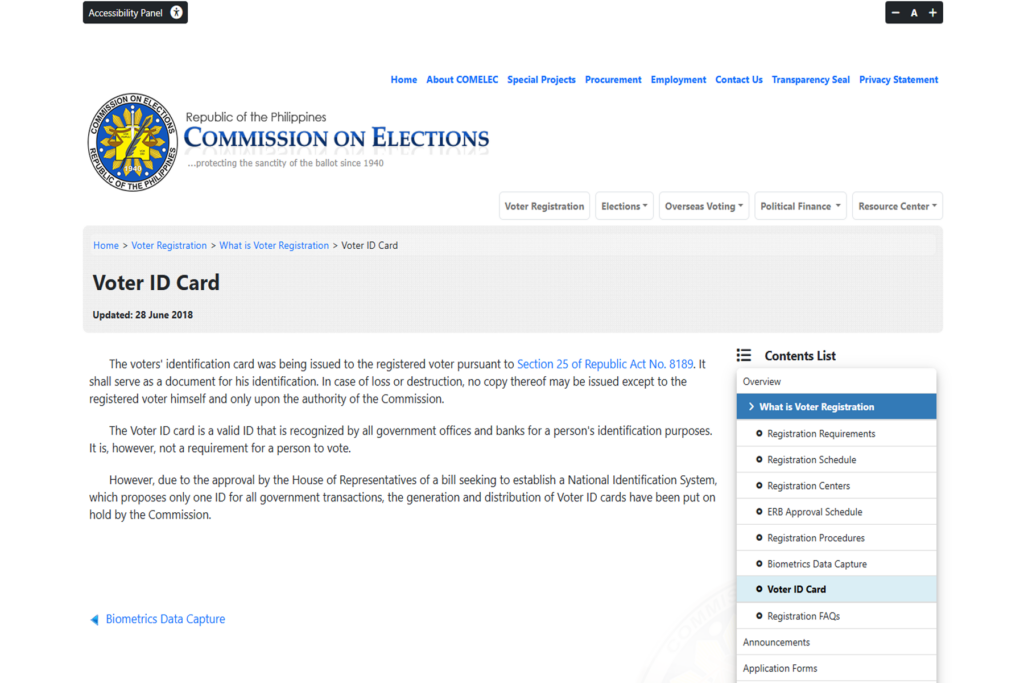
Phase 1: The 2026 Reality Check – COMELEC No Longer Prints the Physical Voters ID
We must address the elephant in the room immediately before you waste your time filing complaints. The Commission on Elections (COMELEC) officially stopped printing and issuing physical Voter’s ID cards several years ago.
1. Why Did the Government Stop Printing the Card?
The cessation of printing was not a random administrative error; it was a highly calculated, direct preparation for the rollout of the Philippine Identification System (PhilSys). Lawmakers realized it was severely redundant and a massive waste of taxpayer money for multiple agencies—COMELEC, SSS, PhilHealth, and Pag-IBIG—to all independently print their own separate ID cards. The federal goal was to securely consolidate all basic demographic data into one foundational credential: the National ID.
If you successfully register as a voter today, your biometrics and identity data will be permanently logged into the highly secure national COMELEC database, granting you the absolute right to vote in all upcoming barangay, mayoral, and presidential elections. However, you will not receive a plastic ID card at the end of the process.
2. Can You Still Vote Without the Physical ID?
Yes, absolutely. This is the most common fear among first-time voters. You do not need the traditional physical Voters ID to cast your ballot on election day. As long as your biometrics are actively captured by the local office, your name is verified in the official COMELEC Precinct Finder, and you can present any standard valid government-issued ID (like a Passport, Driver’s License, or your new PhilSys ID) to the precinct marshals, your constitutional right to vote is 100% protected and guaranteed.
Phase 2: The Ultimate Legal Alternative (The COMELEC Voter’s Certification)
If the physical card is permanently dead, what do you do if a strict bank teller, a passport evaluator at the Department of Foreign Affairs (DFA), or a prospective corporate employer fiercely demands proof of your voter registration?
The legal and universally mandated alternative in 2026 is the COMELEC Voter’s Certification. This is an official, highly secure document printed on specialized, watermarked COMELEC letterhead. It is stamped with the official dry seal of the commission and signed directly by your local Election Officer. By law, all government agencies and private commercial banks must accept this specific certification as a valid primary ID substitute.
How to Secure Your Official Voter’s Certification
If you are already a registered voter with active biometrics in the system, you can easily request this document through two primary channels:
- Local OEO Walk-in Procedure: Physically visit the Office of the Election Officer (OEO) in the exact city or municipality where you are registered. Present at least one valid ID and pay the nominal processing fee (which is usually around ₱75.00). The certification is securely printed, sealed, and handed to you on the very same day.
- COMELEC Main Office (National Central File Division): What if you are actively registered in a distant province (e.g., Cebu or Davao) but currently reside and work in Metro Manila? You do not need to book an expensive flight home. You can simply visit the COMELEC National Central File Division (NCFD) located in Intramuros, Manila, to request a national-level certification.
*Crucial Exemption: The COMELEC Voter’s Certification is completely FREE of charge for Senior Citizens, Persons with Disabilities (PWDs), and recognized members of Indigenous Peoples (IPs) communities, provided they present their respective valid sector IDs upon request.
Phase 3: Strict Eligibility for Voter Registration in the Philippines
Before you can request a certification or step into a voting booth, you must actually register your identity. Voter registration is not a continuous, year-round activity; COMELEC opens specific, strictly enforced “Registration Periods” several months before any upcoming election. You must closely monitor official announcements for these exact dates.
To be legally eligible to register and satisfy the Voters ID Requirements Philippines 2026, you must meet the following constitutional criteria without exception:
- Citizenship: You must be a recognized Filipino citizen (male or female).
- Age Requirement: You must be at least eighteen (18) years of age on or exactly before the day of the succeeding election. (Note: For Sangguniang Kabataan or SK elections, the eligible age bracket is specifically lowered to 15 to 30 years old).
- National Residency: You must have been a continuous resident of the Philippines for at least one (1) full year.
- Local Residency: You must have resided in the specific city, municipality, or district wherein you propose to vote for at least six (6) consecutive months immediately preceding the election day.
- Disqualifications: You must not have been sentenced by final judgment to suffer imprisonment for not less than one year, nor convicted of any crime involving disloyalty to the duly constituted government (unless you have been granted a plenary pardon or amnesty by the President).
Phase 4: The Core Voters ID Requirements Philippines 2026 (Documentary Evidence)
To definitively prove your identity, age, and residency, the local Election Officer will strictly scrutinize your documents. Unlike other lenient government agencies, COMELEC is highly specific and unforgiving about what they accept. You must bring the original copy and a highly legible photocopy of your core Voters ID Requirements Philippines 2026.
You only need to present ONE (1) of the following valid primary IDs:
- PhilSys National ID (Acceptable in physical PVC format, ePhilID paper format, or the Digital National ID via the eGovPH app).
- Valid Philippine Passport (Ensure it is not expired. Check our Passport Requirements Philippines guide if you need a fast renewal).
- Driver’s License (Issued directly by the Land Transportation Office).
- GSIS or SSS UMID Card.
- PRC ID (Professional Regulation Commission).
- IBP ID (Integrated Bar of the Philippines).
- NBI Clearance (Must be valid and unexpired).
- Postal ID (Specifically the new, biometric PVC plastic version).
- Senior Citizen’s ID (Issued by OSCA).
- Student ID or Library Card (Highly applicable for students registering for the first time; it must be signed by the school authority).
- Employee’s ID (Must contain the signature of the corporate employer or authorized HR representative).
- Original PSA Birth Certificate (Mandatory for applicants who are exactly 18 years old to verify their precise legal age).
CRITICAL WARNING: What COMELEC Strictly Does NOT Accept
Do not, under any circumstances, bring a Community Tax Certificate (Cedula), a PNP Police Clearance, or a Barangay Clearance as your primary proof of identity. COMELEC explicitly rejects these documents for voter registration because they are too easily forged, highly unregulated, and do not contain verifiable federal biometrics.
Phase 5: The Registration Process (Walk-in vs. COMELEC iRehistro)
Once your documents are perfectly gathered, you must officially file your application. You have two primary options to initiate the process, but one is vastly superior to the other.
Option A: The Traditional Walk-in Method
- Physically visit the Office of the Election Officer (OEO) in your city or municipality during a designated registration period. Occasionally, COMELEC sets up highly convenient satellite registration booths in major commercial spaces like SM Supermalls or Robinsons.
- Approach the desk and ask for the CEF-1 Form (Application for Registration). Fill out three (3) copies manually using a black ballpoint pen. Ensure your handwriting is perfectly legible.
- Present your filled-out forms and your valid ID to the evaluating officer.
Option B: The iRehistro Online Method (Highly Recommended)
To drastically cut down your waiting time at the municipal hall—which can easily consume your entire day—you must leverage the power of the internet by utilizing comelec online.
- Navigate to the official COMELEC iRehistro portal. This system allows you to legally initiate your application form online registration from the comfort of your home.
- Select “New Registration” and meticulously type your demographic data into the digital CEF-1 form to register. Ensure your name matches your PSA Birth Certificate perfectly.
- Select a strict appointment date and time to visit your local OEO.
- Print the system-generated PDF registration form online on A4 or Legal-sized paper (long bond paper). You must print exactly three (3) copies.
- FATAL ERROR TO AVOID: Do NOT sign or affix your thumbmark at home. By strict election law, the register form online must be physically signed directly in front of the Election Officer under oath. Doing it at home voids the document.
- Go to the OEO on your scheduled appointment date. iRehistro applicants usually have a dedicated express lane, allowing you to bypass the standard form-filling crowds.
The Final Registration Step: Biometrics Capture
Regardless of whether you used Option A or Option B, your final hurdle is the Biometrics Capture. You will sit directly in front of the Voter Registration Machine (VRM) operator. They will take a high-resolution digital photograph of your face, capture your electronic signature via a digital pad, and meticulously scan the fingerprints of all ten of your fingers to prevent future voter fraud.
Once completed, the officer will tear off and hand you a physical acknowledgment receipt stub. Keep this stub extremely safe; it is your ultimate proof that you have successfully registered your identity with the state.
Phase 6: The Ultimate ID Replacement – PhilSys National ID Registration
Because COMELEC will no longer issue you a plastic card, your absolute next mandatory step to fulfill your civil identity requirements is to secure the Philippine Identification System (PhilSys) National ID. This is the ultimate, apex-tier proof of identity in the country, effectively absorbing all the powers of the traditional Voters ID.
1. The Online Demographic Pre-Registration
Your journey begins digitally. You must execute an online registration for national id using a smartphone or computer. Navigate to the official PhilSys Web Portal. This portal acts as your primary gateway to legally philippines register your civil identity.
You will be prompted to input an active mobile number to trigger a One-Time Password (OTP). Once verified, you will access the registration national id online portal. Carefully input your complete demographic data. A single typographical error here will reflect permanently on your printed ID and cause severe rejections during future banking transactions.
2. Physical Biometrics and The eGovPH App
After booking your appointment online, you will receive an Application Reference Number (ARN). Bring this ARN to your chosen PhilSys Registration Center to have your iris scan, fingerprints, and photograph taken. You will be handed a Transaction Reference Number (TRN) upon completion.
You do not need to wait months for the physical PVC card to arrive. Download the official eGovPH app. By completing a facial recognition “liveness” scan, you can execute a national id registration login directly on your smartphone. The app will immediately generate your legally binding Digital National ID, which you can use instantly for all government and banking transactions.
Phase 7: Troubleshooting (Deactivation and Transfer of Registration)
Voter registration is not a permanent guarantee. Your electoral status can be heavily affected by moving across the country or political inactivity.
Why Was My Voter Record Suddenly Deactivated?
Thousands of Filipinos confidently show up on election day only to find their names devastatingly missing from the master list. By law, COMELEC is mandated to automatically deactivate your voter record if you fail to vote in two (2) successive regular elections. To fix this, you do not need to register from scratch. You simply need to visit your local OEO during an active registration period and file an Application for Reactivation. They will pull up your old biometrics and officially restore your active status.
Transferring Registration (Moving to a New City)
If you originally registered in Cebu but permanently relocated to Metro Manila for a corporate job, you cannot vote for Manila’s local officials unless you officially transfer your registration. You must establish residency in your new city for at least six months.
To transfer, go to the OEO of your new city (do not travel back to Cebu) and file an Application for Transfer of Registration Record. Bring a valid ID showing your new exact address, or a utility billing statement under your legal name. The new OEO will securely handle the digital transfer of your biometrics from your old municipality.
WARNING: Beware of Fake PVC Voters IDs on Facebook Syndicates
As the premier authority on fulfilling the Voters ID Requirements Philippines 2026, we must issue a critical, severe warning regarding a massive scam aggressively targeting unaware Filipinos.
Because thousands of people still mistakenly believe they need a physical yellow-and-blue Voter’s ID to open a bank account, criminal syndicates on Facebook, TikTok, and local market stalls offer to “Rush Print your Voter’s ID for ₱300.”
This is a massive trap. It is highly illegal and will destroy your record.
Because COMELEC legally stopped printing these cards years ago, any individual or Facebook page claiming they can print one for you is actively forging a federal government document. They take your name and photo, use a stolen digital template in Photoshop, and print it on a blank PVC card using a cheap commercial ID printer.
If you attempt to present this fake Voter’s ID to a trained bank teller, a loan officer, or a DFA passport evaluator, their UV blacklight scanners and biometric system checks will instantly flag it as a counterfeit. You will be denied service immediately, the fake ID will be permanently confiscated, and you will face severe criminal prosecution for the crime of Falsification of Public Documents, which carries a penalty of imprisonment. Never buy an ID online. Only rely on the official COMELEC Voter’s Certification or your legally acquired PhilSys National ID.
Frequently Asked Questions (FAQs)
To ensure absolute clarity regarding these massive government shifts, we have answered the most pressing questions from Filipino registrants across the country.
Is my old, physical Voters ID completely useless now?
No. If you successfully registered years ago and actually possess the physical blue-and-yellow card, it remains an incredibly powerful, lifelong primary ID. You can continue using it for bank loans, passport renewals, and federal transactions. The only rule that changed is that no *new* physical cards are being printed.
Can I completely register to vote online without visiting the COMELEC office?
No. While the iRehistro system allows you to accomplish the paperwork online, your physical presence at the Office of the Election Officer is strictly mandated by law for Biometrics Capture (fingerprints, signature, and photo). You cannot complete the process purely over the internet.
Can I use the Digital National ID (eGovPH app) to register with COMELEC?
Yes, absolutely. COMELEC officially recognizes the Digital National ID presented via the eGovPH app as a valid, primary proof of identity. They cannot legally refuse it.
⚠ Important Notice and Disclaimer
RequirementPH is a strictly independent, privately-run educational platform. Our core mission is to vastly simplify complex government transactions, eradicate exhausting bureaucratic confusion, and protect the legal identity of every Filipino citizen. We are NOT affiliated, associated, authorized, endorsed by, or in any way officially connected with the Commission on Elections (COMELEC), the Philippine Statistics Authority (PSA), or any government entity.
While our editorial team researches tirelessly to provide the most accurate, up-to-date master guide on the Voters ID Requirements Philippines 2026, official voter registration schedules, specific satellite mall locations, and certification fees are highly dynamic and subject to immediate change based on official COMELEC resolutions. For official precinct finders, voter record verification, or to file a formal application, please transact directly through the official COMELEC website or visit your local Office of the Election Officer.
Your Next Steps & Related Government Guides
Securing your official voter registration and obtaining your certification is a massive step in establishing your foundational legal identity in the Philippines. If you are meticulously preparing your complete portfolio of primary IDs for a major transaction like a real estate housing loan or international travel, make sure to read our other highly detailed master guides:
For vote
yes voters regis
Yes? what can I do to help you?
How can I get my voters id
go to your nearest comelec office