
Complete & Ultimate Extrajudicial Settlement Requirements Philippines 2026 (Easy)
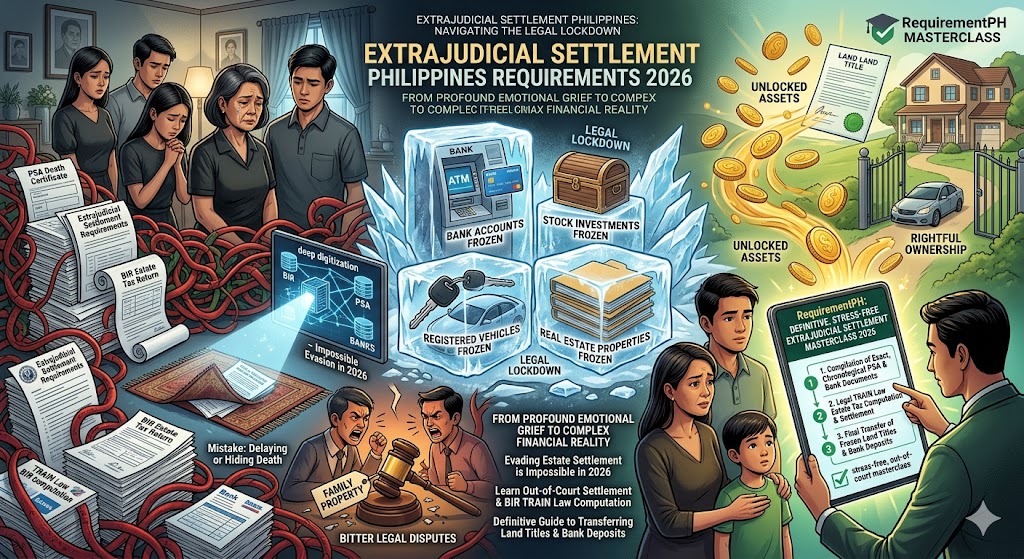
If you are trying to unlock frozen bank accounts or transfer inherited land titles, mastering the complete Extrajudicial Settlement Requirements Philippines is your absolute first step. The passing of a loved one is a period of profound emotional grief, but in the Philippines, it also triggers an immediate, highly complex legal lockdown of their financial assets.
The moment a person dies, their bank accounts, real estate properties, stock investments, and registered vehicles are legally “frozen” by the state. Surviving spouses and children often discover to their horror that they cannot withdraw funds to pay for funeral expenses or sell a family property without first navigating this rigorous legal process.
Many families make the critical mistake of hiding a death from the bank or delaying the transfer of land titles to avoid paying taxes. In 2026, with the deep digitization of the Bureau of Internal Revenue (BIR) and the interconnected databases of the Philippine Statistics Authority (PSA) and local banks, evading estate settlement is impossible.
Attempting to bypass the Extrajudicial Settlement Requirements Philippines results in compounding financial penalties, permanently frozen capital, and bitter legal disputes among heirs that can last for generations.
As the premier authority on Philippine administrative and legal workflows, RequirementPH has engineered this definitive, stress-free masterclass. We will break down the exact, chronological legal steps required.
You will learn how to bypass years of expensive court litigation through an out-of-court settlement, how to legally compute and settle your BIR Estate Taxes under the TRAIN Law, and the exact steps to finally transfer frozen land titles and bank deposits into your rightful name.
Phase 1: Core Extrajudicial Settlement Requirements Philippines (Eligibility)
Before you draft any legal documents or approach the BIR, you must verify if your family is legally permitted to execute this process. An Extrajudicial Settlement allows heirs to divide the estate out of court, saving hundreds of thousands in litigation fees.
However, under Rule 74 of the Rules of Court, you can only use this streamlined method if three strict conditions are met: the deceased left no written will, the deceased left no outstanding debts, and all surviving heirs are of legal age (or minors are represented by a legal guardian) and in complete agreement on the division of assets.
1. Securing the Death Certificate
The entire settlement process is anchored on the official state declaration of passing. You must secure multiple authenticated copies of the Death Certificate Requirements Philippines from the PSA.
If the deceased passed away abroad, the Consular Report of Death must be authenticated. This is the foundational document for the Extrajudicial Settlement Requirements Philippines.
2. Proving Legitimate Heirship (The Civil Registry Mismatch Trap)
The state will not simply take your word that you are the son, daughter, or spouse of the deceased. You must establish an unbreakable paper trail of lineage.
The surviving spouse must present an official PSA Marriage Certificate. All children claiming a share of the estate must present their PSA Birth Certificates.
If a child’s birth certificate contains a typographical error in the deceased parent’s name, the BIR and the banks will immediately disqualify that heir from receiving their share. You must preemptively audit these documents and execute a PSA Birth Certificate Correction if any discrepancies exist.
The identities of all heirs must be backed by Apex-tier Government ID Requirements Philippines, such as a DFA Passport or National ID.
Phase 2: Drafting the Deed of Extrajudicial Settlement
Once you have proven the legal identity of all heirs and gathered the titles and bank statements of the deceased, you must consult a commissioned Notary Public or a specialized estate lawyer. They will draft the actual Deed of Extrajudicial Settlement of Estate. This document is the heart of the Extrajudicial Settlement Requirements Philippines.
1. The Contents of the EJS Document
This is not a simple generic form. The notarized document must meticulously detail the exact nature of the estate. It must include:
- A formal declaration that the deceased died intestate (without a will) and free of outstanding financial obligations.
- The exact legal descriptions of real properties, including the Transfer Certificate of Title (TCT) numbers, municipal locations, and exact land area measurements.
- The exact bank account numbers, branch locations, and current balances for liquid assets.
- The specific fractional division of the properties agreed upon by all participating heirs.
2. Signatures and the OFW Complication
Every single heir must sign the document. If an heir is currently working abroad as an Overseas Filipino Worker, they cannot sign a scanned copy.
They must execute a Special Power of Attorney (SPA) authenticated by the Philippine Embassy or Consulate in their host country, designating a representative in the Philippines to sign on their behalf. Before leaving for deployment, families should always review the OFW Document Requirements to ensure consular protocols are understood.
Phase 3: The Mandatory Publication Requirement
Under Philippine law, an Extrajudicial Settlement is not legally binding against third parties (such as hidden creditors or undiscovered illegitimate children) unless the public is officially notified of the settlement. Meeting this rule is a non-negotiable part of the Extrajudicial Settlement Requirements Philippines.
1. The Three-Week Newspaper Publication
After notarization, you must bring the EJS document to the local municipal court to be raffled to a recognized newspaper of general circulation within the province or city where the deceased resided. The notice of the Extrajudicial Settlement must be published once a week for three (3) consecutive weeks.
Once the three weeks have elapsed, the publisher will issue an Affidavit of Publication alongside physical newspaper clippings. Keep these safe, as the BIR and the Registry of Deeds will completely reject your application without this exact proof of publication.
Phase 4: BIR Estate Tax Gauntlet (Crucial Extrajudicial Settlement Requirements Philippines)
This is the most intimidating and financially crucial phase of the Extrajudicial Settlement Requirements Philippines. You must settle the Estate Tax with the BIR Revenue District Office (RDO) that has jurisdiction over the last known residence of the deceased.
1. The 6% Flat Estate Tax Rate (TRAIN Law)
Prior to 2018, estate taxes were subjected to a complex graduated bracket system that bankrupt many families. Under the current TRAIN Law framework for 2026, the estate tax is now a highly simplified, flat rate of 6% of the net estate value.
Furthermore, the law provides massive standard deductions. If the deceased’s primary family home (Family Home Deduction) and standard cash assets fall below certain multi-million peso thresholds, the family may owe zero estate tax. However, even if you owe zero tax, you must still file the paperwork.
2. Filing BIR Form 1801 and Required Attachments
You have exactly one (1) year from the date of death to file BIR Form 1801 (Estate Tax Return) and pay any corresponding taxes. Missing this deadline incurs a 25% surcharge and 12% annual interest.
You must submit the following massive dossier to the BIR to fulfill the Extrajudicial Settlement Requirements Philippines:
- The Notarized Deed of Extrajudicial Settlement.
- The Affidavit of Publication from the newspaper.
- Certified True Copies of all Land Titles (TCT/CCT) from the Registry of Deeds.
- Updated Tax Declarations from the municipal Assessor’s Office.
- Bank certifications stating the exact deposit balance at the time of death.
- Active TINs for the deceased and all inheriting heirs.
3. Securing the Electronic Certificate Authorizing Registration (eCAR)
Once the BIR evaluator computes your tax, you will pay the amount at an Authorized Agent Bank (AAB). Upon submitting the deposit slip, the BIR will process and issue the Electronic Certificate Authorizing Registration (eCAR).
The eCAR is the holy grail of estate settlement; it is the ultimate federal clearance proving the state has been paid. Neither a bank manager nor the Registry of Deeds can legally transfer assets to your name without verifying this eCAR.
Phase 5: Transferring Real Estate & Liquidating Bank Accounts
With the BIR eCAR in hand, the federal tax roadblock is cleared. You have almost completed the Extrajudicial Settlement Requirements Philippines. You must now physically travel to the respective institutions to execute the final transfers.
1. Releasing Frozen Bank Accounts
To access the cash, proceed to the specific bank branch where the deceased held their accounts. Present the original Notarized EJS, the Affidavit of Publication, the PSA Death Certificate, the BIR eCAR, and your primary Valid IDs.
The bank manager will legally release the funds, usually via a manager’s check payable to the heirs, effectively closing the deceased’s account.
2. Transferring Land Titles at the Registry of Deeds (ROD)
Transferring real property inherited through an estate operates similarly to standard property sales but without the Capital Gains Tax. You must first pay the Local Transfer Tax at the municipal Treasurer’s office where the land is located.
Once paid, submit your complete dossier—including the old title, the EJS, and the BIR eCAR—to the Registry of Deeds.
To fully understand the municipal transfer tax computation and the exact ROD releasing timelines, you must cross-reference this process with our comprehensive guide on Land Title Transfer Requirements Philippines. Once the new title is released, do not forget to update the Tax Declaration at the Assessor’s Office to reflect the heirs’ names.
Phase 6: Specialized Assets (Vehicles, Shares, and Business Clearances)
If the deceased owned active business operations, corporate stocks, or motor vehicles, specialized secondary clearances are required to finalize the Extrajudicial Settlement Requirements Philippines.
- Motor Vehicles (LTO): To transfer a car or motorcycle, you must bring the eCAR and the EJS to the Land Transportation Office. Furthermore, the vehicle must pass the standard Clearance Requirements Philippines (PNP-HPG) and emission testing before a new Certificate of Registration (CR) is printed.
- Corporate Stocks: The eCAR must be presented to the Corporate Secretary of the company where the deceased held shares to update the Stock and Transfer Book.
- Business Closures: If the deceased operated a sole proprietorship, the heirs must formally close the business with the BIR and DTI to stop tax liabilities from accumulating, or legally transfer the assets. Review the commercial frameworks in our Small Business Registration Requirements Philippines index.
⚠ Important Legal & Taxation Notice
RequirementPH operates strictly as an independent, privately-funded educational index designed to map complex public administrative workflows in the Philippines.
We are NOT affiliated, associated, authorized, endorsed by, or in any way officially connected with the Bureau of Internal Revenue (BIR), the Land Registration Authority (LRA), or the Philippine Statistics Authority (PSA).
The information provided in this guide regarding the Extrajudicial Settlement Requirements Philippines does not constitute formal legal counsel. Estate taxation, standard deduction ceilings, and inheritance laws under the Civil Code are highly intricate and subject to immediate legislative amendments.
Filing an Extrajudicial Settlement incorrectly can result in severe financial penalties and the permanent forfeiture of legal rights. It is highly recommended to retain the services of an accredited Certified Public Accountant (CPA) or a licensed Estate Lawyer to navigate the BIR computations.
Always execute your final tax filings exclusively through verified `.gov.ph` portals or authorized bank channels. For official legal texts regarding the National Internal Revenue Code and the TRAIN Law, verify directly with the Bureau of Internal Revenue (BIR) and cross-reference with the Official Gazette of the Republic of the Philippines.
Strategic Resource Links for Beneficiaries
To ensure your family’s civil documents are fully aligned before approaching the Bureau of Internal Revenue, cross-reference your records with our central pillar guides:
- Complete Civil Registry Requirements Philippines 2026 (Resolving Parent-Child Name Mismatches)
- Government Pension Requirements Philippines (Claiming Survivorship Pensions from SSS/GSIS)
- CENOMAR Requirements Philippines (Proving Legal Status for Single Heirs)
- Pag-IBIG Housing Loan Requirements Philippines (Assuming Encumbered Mortgages)