
Complete & Ultimate LTO Motor Vehicle Transfer Requirements Philippines 2026 (Easy)
If you recently purchased a second-hand car or motorcycle, mastering the complete LTO Motor Vehicle Transfer Requirements Philippines is your most critical legal obligation. Buying a used vehicle is an exciting financial milestone, but handing over the cash and driving the unit home does not make you the legal owner in the eyes of the government.
In the Philippines, the law operates under the “Registered Owner Rule.” This means that whoever is named on the yellow Certificate of Registration (CR) is strictly liable for any accidents, traffic violations, or crimes involving that specific vehicle. If you do not formally transfer the ownership, you risk massive legal liabilities or face the danger of discovering you purchased a carnapped vehicle.
Thousands of buyers rely on a dangerous practice known as the “Open Deed of Sale” to avoid paying transfer taxes and LTO processing fees. In 2026, the Land Transportation Office (LTO) and the Philippine National Police Highway Patrol Group (PNP-HPG) have heavily integrated their digital tracking systems.
Attempting to bypass the LTO Motor Vehicle Transfer Requirements Philippines will result in vehicle impoundment, severe financial penalties, and the inability to renew your annual vehicle registration via the LTMS portal.
As the ultimate authority on Philippine administrative workflows, RequirementPH has engineered this definitive, stress-free masterclass. We will break down the exact, chronological legal steps required to clear your vehicle.
You will learn how to verify a clean vehicle history, secure your mandatory police clearances, and safely execute the final transfer at the LTO without falling victim to bureaucratic red tape or fake fixers.
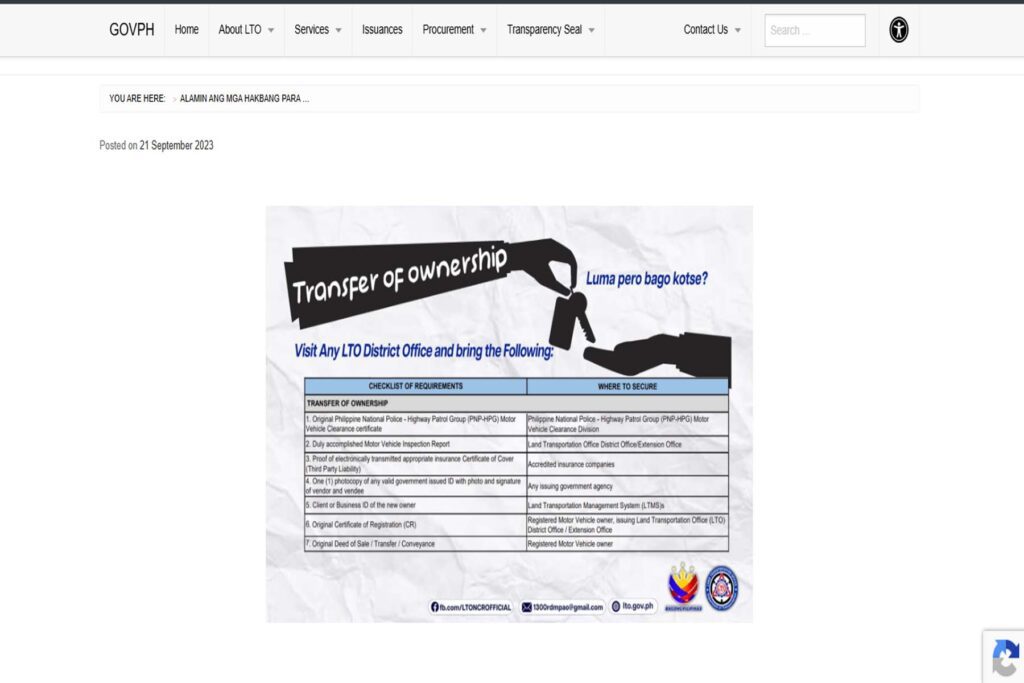
Phase 1: Pre-Purchase Due Diligence (Never Skip This)
Before you even sign a contract or prepare your LTO Motor Vehicle Transfer Requirements Philippines, you must conduct uncompromising due diligence. Buying a car with a tampered chassis number or an active alarm will result in immediate confiscation by authorities.
1. Verifying the Original OR/CR
The seller must present the original, unlaminated LTO Certificate of Registration (CR) and the latest Official Receipt (OR) proving the vehicle is currently registered for the year. Do not accept photocopies during the final exchange.
Check the encumbrance section on the CR. If the car was originally bought through a bank loan, it will have an annotation. You cannot transfer the vehicle unless the seller provides a “Release of Chattel Mortgage” from the bank, proving the auto loan is fully paid.
2. LTO and HPG SMS Verification
You can instantly check if a vehicle has pending alarms, LTO apprehensions, or carnapping reports. You must visually match the engine and chassis numbers on the physical vehicle against the numbers printed on the CR.
If the engine was replaced by a previous owner but not officially recorded at the LTO, the PNP-HPG will flag it as an illegal assembly. Walk away from the sale immediately if the physical numbers look filed down, welded, or tampered with.
Phase 2: Executing the Deed of Absolute Sale (DOAS)
The formal transition of ownership begins with the Deed of Absolute Sale for a Motor Vehicle. This notarized document is the foundational paper for the LTO Motor Vehicle Transfer Requirements Philippines.
1. Drafting the DOAS
The Deed must contain highly specific details. It requires the exact Make, Series, Body Type, Year Model, Plate Number, Engine Number, and Chassis Number of the vehicle. A single typo in these alphanumeric strings will cause the LTO to reject your transfer application.
2. Signatures and Valid IDs
The seller (vendor) and the buyer (vendee) must both sign the DOAS. If the seller is married, their spouse must also sign the marital consent portion to prevent future legal disputes over conjugal assets.
To have the document notarized, you must present apex-tier credentials. Review our Complete Government ID Requirements Philippines to ensure you have a valid passport, PRC ID, or PhilSys National ID. The notary public will require clear photocopies of the seller’s IDs bearing three (3) specimen signatures.
Furthermore, ensure the seller’s signature matches the signature on their IDs perfectly. If the seller is a registered corporation, they must provide a Secretary’s Certificate authorizing the sale. You can cross-reference corporate document handling in our Small Business Registration Requirements guide.
Phase 3: The PNP-HPG Motor Vehicle Clearance
Before the Land Transportation Office will even look at your transfer application, you must secure a clearance from the Highway Patrol Group (HPG) of the Philippine National Police. This is a non-negotiable step in the LTO Motor Vehicle Transfer Requirements Philippines.
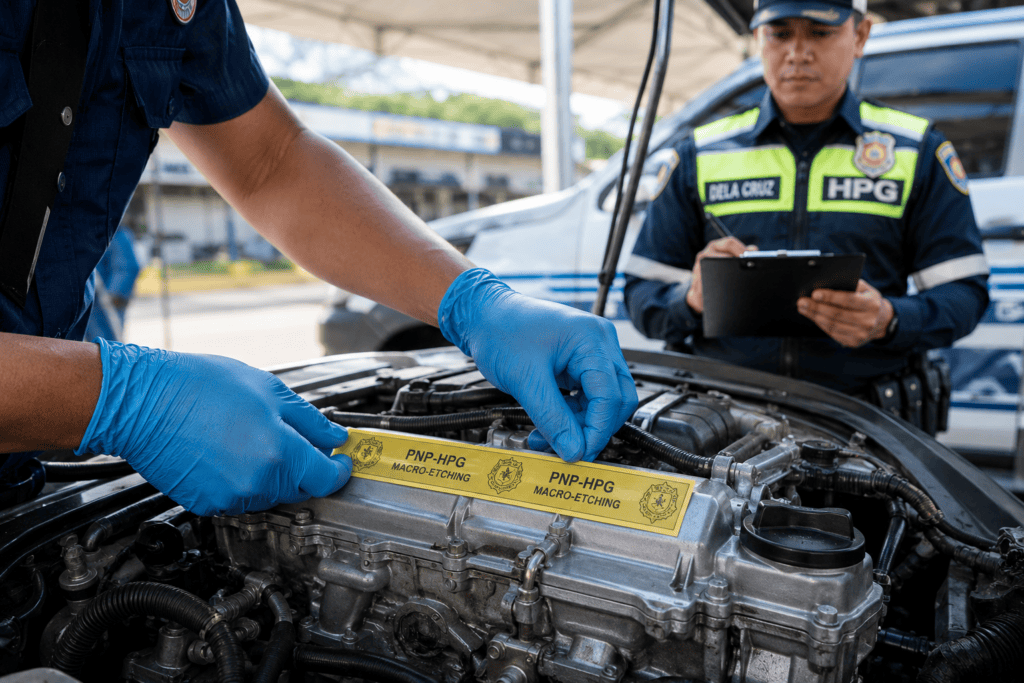
1. The Macro-Etching (Stenciling) Process
You must bring the physical vehicle to the nearest PNP-HPG motor vehicle clearance division (often located near Camp Crame or regional police headquarters). An authorized HPG officer will perform “macro-etching” or stenciling on the engine and chassis numbers.
They use a special chemical and tape to lift the physical imprint of the numbers directly from the metal block. This ensures the numbers have not been altered or ground down by car thieves.
2. Submitting the HPG Requirements
To process the clearance, you must submit a specific dossier to the HPG evaluation window. This includes:
- The original Notarized Deed of Absolute Sale.
- The original LTO CR and the latest OR.
- Two (2) Valid IDs of both the original owner (seller) and the new owner (buyer) with three specimen signatures.
- A printed PNP National Police Clearance (depending on the regional HPG branch’s specific mandate for the buyer).
Once you pay the requisite Landbank fees for the clearance, you will wait roughly 3 to 5 working days for the release of the official PNP-HPG Motor Vehicle Clearance Certificate.
Phase 4: Mandatory Emission Testing and Insurance (CTPL)
You are now halfway through the LTO Motor Vehicle Transfer Requirements Philippines. The next phase focuses on ensuring the vehicle is roadworthy and legally insured under the new owner’s name.
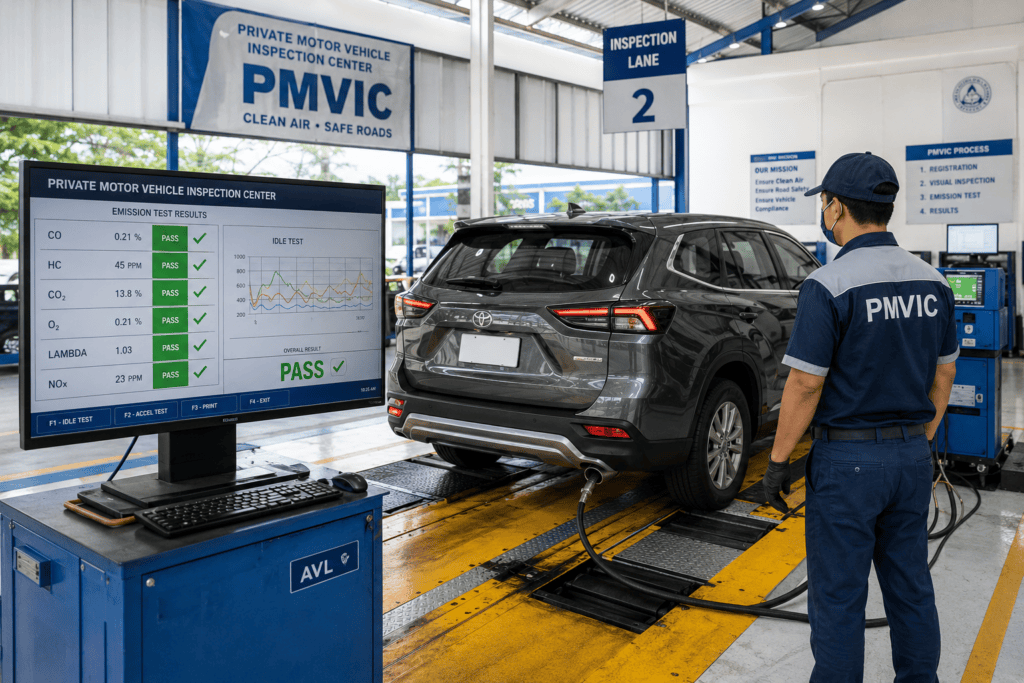
1. Private Motor Vehicle Inspection Center (PMVIC)
In 2026, standard emission testing centers are being heavily phased out in favor of comprehensive PMVICs. You must bring the vehicle to an LTO-accredited PMVIC.
The facility will test not only exhaust emissions but also brake efficiency, suspension, headlights, and speedometer accuracy. The results are electronically transmitted directly to the LTO LTMS portal. If the vehicle fails, you must repair it and have it re-tested before you can proceed.
2. Compulsory Third Party Liability (CTPL) Insurance
You cannot register or transfer a vehicle without basic state-mandated insurance. You must purchase a CTPL policy under your name (the new buyer). Ensure you provide the insurance agent with the Notarized Deed of Sale so the policy correctly reflects the new impending ownership.
This insurance covers death or bodily injury to third parties in the event of an accident. The insurance provider will instantly upload your Certificate of Cover (COC) electronically to the LTO database.
Phase 5: The Final Transfer at the LTO Branch
With all supporting clearances secured, you are ready to execute the final step of the LTO Motor Vehicle Transfer Requirements Philippines. You must bring the vehicle and your complete physical dossier to the LTO District Office where the vehicle’s original “Mother File” is kept, or request a file transfer if you are applying in a different region.
1. The Master LTO Transfer Checklist
Proceed to the LTO evaluator’s window and submit the following arranged documents:
- The Original LTO Certificate of Registration (CR) and latest Official Receipt (OR).
- The Original Notarized Deed of Absolute Sale.
- The Original PNP-HPG Motor Vehicle Clearance Certificate.
- The PMVIC Inspection Report (electronically verified).
- The CTPL Insurance Certificate of Cover (electronically verified).
- The duly accomplished LTO Motor Vehicle Inspection Report (MVIR) form.
- Tax Identification Number (TIN) of the buyer.
2. Payment and Releasing of the New CR
The LTO evaluator will assess your documents. Once approved, you will proceed to the cashier to pay the transfer of ownership fee, the computer fee, and any penalties for late registration if the current OR has already expired.
After payment, wait for your name to be called at the releasing window. The LTO will officially cancel the old CR and print a brand-new Certificate of Registration bearing your name. You are now legally the absolute owner of the vehicle.
Phase 6: Updating Toll Expressways and Post-Transfer Tasks
The LTO Motor Vehicle Transfer Requirements Philippines process concludes at the LTO, but a responsible car owner must execute one final phase. You must update the vehicle’s electronic toll collection systems.
1. Autosweep and Easytrip Account Transfers
If the vehicle came with existing Autosweep (SLEX/Skyway) or Easytrip (NLEX/CAVITEX) RFID tags, they are still linked to the previous owner’s name, email, and digital wallet. You must visit an RFID customer service kiosk with your newly printed LTO CR and your valid IDs to formally request a transfer of account ownership.
2. Inherited Vehicles (Special Case)
If you acquired the vehicle because the original registered owner passed away, a standard Deed of Sale is invalid. You cannot forge the signature of a deceased person. The family must first settle the estate.
You must present a BIR eCAR and a notarized settlement document to the LTO. To understand this highly specific legal route, you must master the Extrajudicial Settlement Requirements Philippines before initiating the vehicle transfer.
⚠ Important Legal & Transport Notice
RequirementPH operates strictly as an independent, privately-funded educational index designed to map complex public administrative workflows in the Philippines.
We are NOT affiliated, associated, authorized, endorsed by, or in any way officially connected with the Land Transportation Office (LTO), the Philippine National Police Highway Patrol Group (PNP-HPG), or the Department of Transportation (DOTr).
The information provided in this guide regarding the LTO Motor Vehicle Transfer Requirements Philippines does not constitute formal legal counsel. Registration fees, PMVIC emission standards, and HPG clearance protocols are highly intricate and subject to immediate legislative amendments.
Failing to transfer a vehicle formally can result in severe legal liabilities under the Registered Owner Rule. Never rely on illegal third-party “fixers” offering to bypass HPG macro-etching or LTO inspections; presenting falsified documents will result in the permanent impoundment of the vehicle and criminal prosecution.
Always execute your final vehicle registration exclusively through verified LTO district offices. For official legal texts regarding land transportation laws and penalty matrices, verify directly with the Land Transportation Office (LTO) and cross-reference with the Official Gazette of the Republic of the Philippines.
Strategic Resource Links for Vehicle Owners
To ensure your personal identification and licensing documents are fully aligned before approaching the LTO, cross-reference your records with our central pillar guides:
- Driver’s License Requirements Philippines 2026 (Renewing Your Professional & Non-Pro Licenses)
- Complete Government ID Requirements Philippines (Securing Apex IDs for Notarization)
- Clearance Requirements Philippines (Mapping Your Police & NBI Background Checks)
- Small Business Registration Requirements Philippines (For Registering Commercial Delivery Fleets)