#1 Ultimate PhilHealth Contribution Table 2026 (Updated Rates & Complete Guide)
Every time payday arrives in the Philippines, workers immediately check their payslips to see their net take-home pay. Among the mandatory government deductions—which include SSS and Pag-IBIG—the PhilHealth premium has become one of the most closely monitored. With the full implementation of the Universal Health Care (UHC) Act, premium rates have steadily increased, causing confusion and concern among both employees and business owners.
In 2026, the Philippine Health Insurance Corporation (PhilHealth) enforces its maximum mandated contribution rate. Understanding this updated schedule is no longer just a task for HR professionals and payroll accountants; it is an absolute necessity for every single Filipino worker. If you do not know how your premiums are calculated, you could be overcharged by your employer, or worse, you might face suspended health benefits during a critical medical emergency because your voluntary payments were insufficient.
As your definitive and most trusted authority on Philippine government transactions, RequirementPH has built this ultimate, foolproof masterclass. We will break down the exact mathematics of the PhilHealth Contribution Table 2026, provide real-world computation examples for different salary brackets, explain the strict rules for OFWs and Kasambahays, and teach you how to legally protect yourself from employer remittance fraud.

Understanding the PhilHealth Contribution Table 2026 Rate Increase
To understand why your deductions are higher today than they were five years ago, we must look at the law. In 2019, the Philippine government passed Republic Act No. 11223, universally known as the Universal Health Care (UHC) Act. The primary goal of this monumental legislation was to automatically enroll every Filipino citizen into the National Health Insurance Program, ensuring that no one is denied hospital admission due to poverty.
However, expanding health coverage to over 110 million Filipinos requires massive funding. To sustain the agency’s fund life and pay for expanded benefits like the Z-Benefits for cancer treatments and the free Konsulta primary care package, the UHC Law mandated a staggered increase in direct contributor premiums.
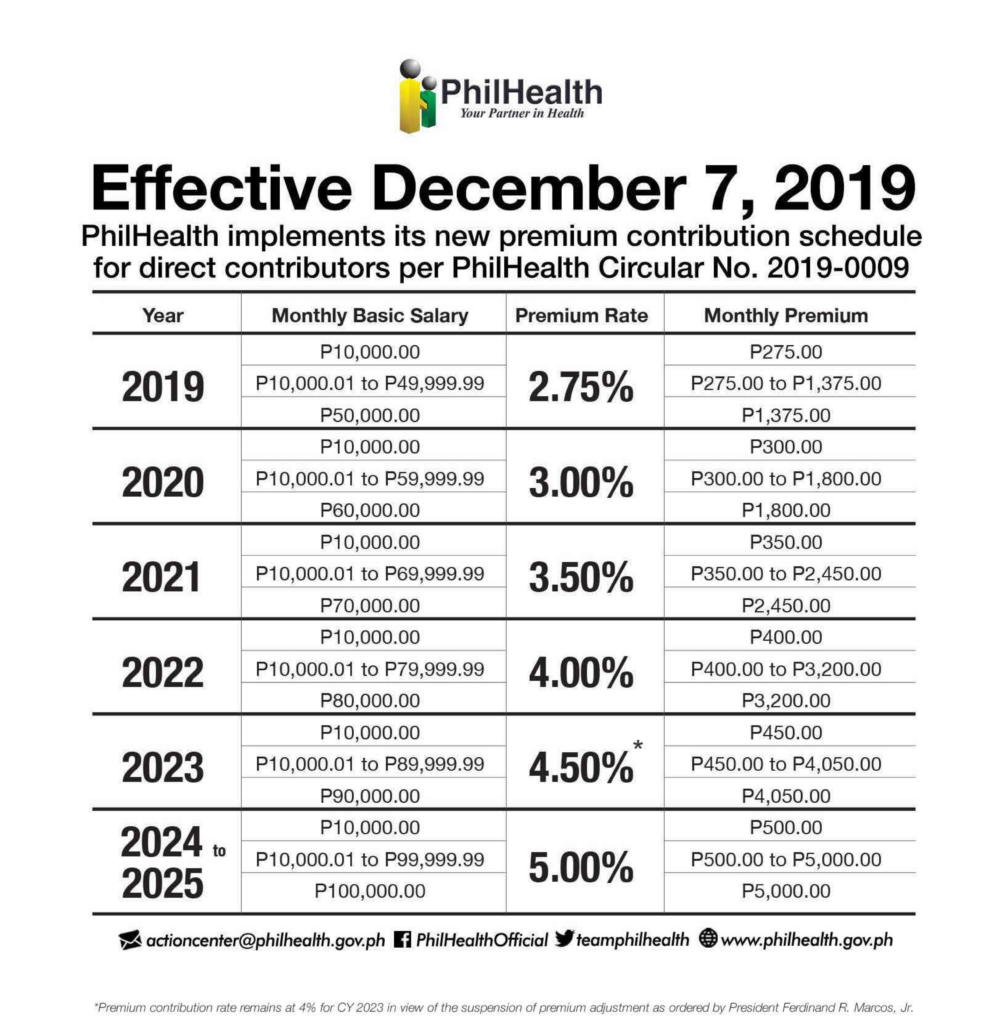
The rate started at 2.75% in 2019 and was legally scheduled to increase by 0.5% every subsequent year until it hit its ceiling. For 2026, the total PhilHealth premium contribution rate is strictly set at 5.00% of a member’s basic monthly income.
The Income Floor and Income Ceiling Rule
The 5% rate does not infinitely apply to any salary amount. PhilHealth utilizes an “Income Floor” and an “Income Ceiling” to protect minimum wage earners and cap the burden on high-income executives.
- The Income Floor (₱10,000): If you earn ₱10,000 or below (including part-time workers), your contribution is computed exactly at the ₱10,000 baseline. You will never pay less than the minimum mandated premium.
- The Income Ceiling (₱100,000): If you are a high-earning executive making ₱150,000 or ₱200,000 a month, your PhilHealth deduction does not keep growing. The computation stops at the ₱100,000 ceiling. You will only be billed 5% of ₱100,000.
Official PhilHealth Contribution Table 2026 Breakdown
For formally employed individuals in the private sector and government agencies, the financial burden of the 5.00% premium is not shouldered alone. It is legally split right down the middle: 50% is paid by the Employee, and 50% is subsidized by the Employer. This means the employee pays 2.5%, and the employer pays the other 2.5%.
Here is the official structural breakdown of the brackets:
- Basic Monthly Salary: ₱10,000 and below
Total Monthly Premium: ₱500.00
Employee Share: ₱250.00
Employer Share: ₱250.00 - Basic Monthly Salary: ₱10,000.01 to ₱99,999.99
Total Monthly Premium: 5.00% of the actual basic monthly salary
Employee Share: 2.50% of the basic monthly salary
Employer Share: 2.50% of the basic monthly salary - Basic Monthly Salary: ₱100,000 and above
Total Monthly Premium: ₱5,000.00
Employee Share: ₱2,500.00
Employer Share: ₱2,500.00
Real-World Computations: How Much Will Be Deducted?
Looking at percentages can be confusing. To ensure your HR department or payroll software is deducting the exact and lawful amount from your payslip, let us break down the math using three distinct, real-world salary scenarios under the PhilHealth Contribution Table 2026 guidelines.
Scenario A: The Minimum Wage Earner
Juan works as a retail clerk in a provincial mall, earning a basic monthly salary of ₱10,000.
- Formula: ₱10,000 x 0.05 (5%) = ₱500.00 Total Premium
- Juan’s Payslip Deduction (50% share): ₱250.00
- Employer’s Counterpart (50% share): ₱250.00
Scenario B: The Mid-Level Corporate Worker
Maria is an IT Supervisor in Metro Manila with a basic monthly salary of ₱40,000. Note: Allowances, bonuses, and overtime pay are NOT included in the PhilHealth basic salary computation.
- Formula: ₱40,000 x 0.05 (5%) = ₱2,000.00 Total Premium
- Maria’s Payslip Deduction (50% share): ₱1,000.00
- Employer’s Counterpart (50% share): ₱1,000.00
Scenario C: The Executive Level Earner
Carlos is a Vice President of a logistics firm earning ₱180,000 a month. Because his salary exceeds the legal ceiling, the computation stops at exactly ₱100,000.
- Formula: ₱100,000 (Ceiling limit) x 0.05 (5%) = ₱5,000.00 Total Premium
- Carlos’s Payslip Deduction (50% share): ₱2,500.00
- Employer’s Counterpart (50% share): ₱2,500.00
Self-Employed, Freelancers, and Voluntary Members
The gig economy in the Philippines is booming. Millions of Filipinos work as Upwork freelancers, Grab drivers, TikTok shop owners, and independent consultants. If you fall under this category, you are classified as a Direct Contributor, but the financial rules are significantly different.
Because you do not have a corporate employer to subsidize half of your premium, you must shoulder the entire 5.00% yourself.
When you update your PhilHealth Member Registration Form (PMRF) to “Self-Earning Individual,” you must declare your estimated monthly income. If you declare an income of ₱20,000, you must personally generate a Statement of Premium Account (SPA) on your online portal and pay the full ₱1,000 every month to keep your health coverage active. You can opt to pay this monthly, quarterly, semi-annually, or annually to avoid missing deadlines.
Special Rules for Kasambahays and OFWs
The government enforces highly specific protective guidelines for vulnerable workers, particularly domestic helpers and overseas workers.
The Kasambahay Law (RA 10361)
If you employ a Kasambahay (maid, driver, yaya, gardener), you cannot simply deduct 2.5% from their salary without looking at the baseline. Under the Kasambahay Law:
- If the Kasambahay earns less than ₱5,000 a month, the employer must shoulder the entire PhilHealth premium. You are legally forbidden from deducting a single peso from their salary.
- If the Kasambahay earns ₱5,000 or more a month, the standard 50-50 split applies based on the PhilHealth Contribution Table 2026.
Overseas Filipino Workers (OFWs)
For land-based OFWs, paying PhilHealth is legally mandatory before deployment. The premium is based on 5.00% of their declared monthly salary equivalent in Philippine Pesos. However, the Department of Migrant Workers (DMW) and PhilHealth usually allow an initial advance payment (typically around ₱2,400 to ₱3,000) prior to the issuance of the Overseas Employment Certificate (OEC), with the remaining balance to be paid throughout the year.
What to Do If Your Employer Commits Remittance Fraud
One of the most tragic scenarios in the Philippine workforce occurs when an employee is rushed to the emergency room, only to be told by the hospital billing department that their PhilHealth is inactive. When the employee checks their payslip, they clearly see that 2.5% has been deducted every single month by their HR department.
If an employer deducts money from your salary but fails to remit it to the government, they are committing a severe criminal offense (Estafa and violation of the National Health Insurance Act).
Your Action Plan:
- Verify Online: Do not rely on hearsay. Log in to your PhilHealth Member Portal online and check your “Contribution History.” If the months are blank, take a screenshot immediately.
- Gather Evidence: Collect your physical or digital payslips showing the exact PhilHealth deductions.
- Demand Reconciliation: Send a formal email to your HR and Payroll department demanding proof of remittance. Give them 3 to 5 working days to resolve the floating payments.
- Report to Authorities: If the company ignores you or refuses to pay, go directly to the nearest Local Health Insurance Office (LHIO). Bring your printed portal screenshots and payslips. PhilHealth’s legal team will issue a demand letter to your employer, and if ignored, will file criminal charges against the company’s directors.
WARNING: Beware of “Discounted Premium” Scams on Facebook
As the premium rates have increased to 5%, a massive black market of “Online Fixers” has flooded Facebook groups. You will see posts claiming: “Update your PhilHealth instantly! Pay only 50% of your premium balance. Legit transaction.”
Do not engage with these syndicates under any circumstances.
PhilHealth contribution rates are hard-coded into the national database by law. Absolutely no one—not even the President of the Philippines—can legally offer you a “discount” on your mandatory premiums.
What these scammers do is take your money and use Photoshop to edit a fake PhilHealth Official Receipt (POR) or an edited screenshot of the portal. They will block you on Messenger and disappear. When you try to claim your hospital benefits months later, the system will show your account in default, rendering you entirely responsible for your massive hospital bills. Always pay your premiums directly through the official PhilHealth Member Portal using accredited gateways like GCash, Maya, or directly via online banking.
⚠ Important Notice and Disclaimer
RequirementPH is an independent, privately-run educational platform. Our core mission is to simplify complex government transactions, eradicate bureaucratic confusion, and boost the financial literacy of every Filipino worker. We are NOT affiliated, associated, authorized, endorsed by, or in any way officially connected with the Philippine Health Insurance Corporation (PhilHealth) or any government entity.
While we research tirelessly to provide the most accurate, up-to-date guide on the PhilHealth Contribution Table 2026, internal premium caps, income floors, and specific OFW directives are subject to change based on official PhilHealth circulars and potential legislative amendments to the UHC Law. For official billing statements, account troubleshooting, or to report employer fraud, please transact directly through the official PhilHealth website or visit your nearest regional health insurance office.
Your Next Steps & Related Guides
Ensuring your health insurance premiums are up to date is a massive step in establishing your family’s medical safety net. If you are reviewing your payslip deductions or preparing your pre-employment documents for a new job, make sure your entire government portfolio is completely secure by checking out our other highly detailed master guides: