
#1 Ultimate Civil Service Exam Requirements Philippines 2026 (Complete CSC Guide)
Working for the Philippine government comes with incredible benefits: lifetime job security, competitive salary grades, GSIS pensions, and substantial bonuses. However, before you can even submit your resume to a government agency, you must cross the ultimate bureaucratic hurdle: passing the Civil Service Examination – Pen and Paper Test (CSE-PPT).
Securing a slot to take this exam is notoriously difficult. The Civil Service Commission (CSC) operates on a “first-come, first-served” basis, and regional quotas are often filled within hours of opening. If you arrive at the CSC regional office missing a single signature, or if your ID picture does not meet their insanely strict specifications, your application will be instantly rejected, and you will have to wait another six months for the next exam batch.
Furthermore, the CSC has fully implemented the Online Civil Service Examination Application System (OCSAS) for 2026, meaning walk-ins without digital appointments are no longer entertained. As your definitive authority on Philippine government transactions, RequirementPH has built this foolproof, comprehensive masterclass.
We will break down the exact Civil Service Exam Requirements Philippines 2026, teach you how to dominate the OCSAS portal to secure a slot, explain the famously strict ID picture rules, and reveal the legal exemptions that might mean you don’t even need to take the exam at all.
Crucial Check: Do You Actually Need to Take the CSE?
Before you stress about the Civil Service Exam Requirements Philippines 2026, you must verify if you are already exempted by law. Thousands of Filipinos waste time and money applying for an exam they do not need to take.
1. The PRC Exemption (Republic Act No. 1080)
If you are a licensed Nurse, Engineer, Teacher, CPA, or any professional who passed a board exam given by the Professional Regulation Commission (PRC), stop right now. You are automatically granted Civil Service Eligibility. You do not need to take the CSE. Your active PRC ID acts as your eligibility. If your license is currently expired, simply follow our PRC ID Renewal Online Philippines master guide to reactivate your status and instantly apply for government positions.
2. The Honor Graduate Exemption (Presidential Decree No. 907)
Did you graduate Summa Cum Laude, Magna Cum Laude, or Cum Laude from a CHED-recognized university? Under PD 907, you are automatically granted Professional Civil Service Eligibility. You do not take the exam; you simply submit your Transcript of Records and a specific application form to the CSC to claim your Honor Graduate Eligibility (HGE) certificate.
3. Barangay Official Eligibility (BOE)
If you served a full term as a Barangay Captain, Sangguniang Barangay Member, SK Chairman, or appointed Barangay Secretary/Treasurer, you may be eligible for the BOE, which is equivalent to Sub-Professional eligibility.
Professional vs. Sub-Professional: Which Should You Take?
If you do not qualify for the exemptions above, you must take the exam. You have to choose between two levels during your application:
- Professional Level: For college graduates (or those who have completed at least 72 college units). This eligibility qualifies you for both first-level (clerical) and second-level (technical/managerial) government positions. The exam is harder and includes analytical questions.
- Sub-Professional Level: For high school graduates. This eligibility only qualifies you for first-level (clerical, trade, or custodial) positions. The exam does not have analogies or logic questions, focusing instead on clerical operations.
Core Civil Service Exam Requirements Philippines 2026
Once you secure your online appointment, you must present a highly specific physical portfolio at the CSC Regional Office. Prepare original copies and photocopies.
1. Fully Accomplished CS Form No. 100
You must download and print the CS Form No. 100 (Revised September 2016). Print it on Legal Size (8.5 x 14 inches) bond paper. Fill it out completely using a black ballpoint pen. WARNING: Leave the signature and thumbprint sections completely blank! You are only allowed to sign and affix your thumbprint in front of the CSC processor.
2. Four (4) Passport Size ID Pictures (The Strictest Rule)
The CSC will reject your application instantly if your photo is wrong. You must bring four identical passport-size photos that strictly follow these rules:
- Taken within the last 3 months with a stark white background.
- You must be wearing a collared shirt or blouse (no sleeveless).
- Your face must be totally bare. No eyeglasses, no colored contact lenses, no heavy makeup, and both ears must be clearly visible.
- The Handwritten Nametag: The photo must have a physical nametag positioned exactly at the chest area. The nametag must display your Signature over Printed Full Name in this exact format: First Name, Middle Initial, Last Name, and Extension Name (if any). Computer-edited nametags are strictly forbidden. You must hold a physical piece of paper while the photo is taken.
3. Original and Photocopy of Valid Primary ID
You must present a highly secure, unexpired primary identification card. Accepted IDs include the Philippine Passport, PhilSys National ID, UMID, Postal ID, and Voter’s ID. If you only recently started driving, check if your permit was issued as a physical card, or read our LTO Student Permit Requirements Philippines guide to upgrade to a Non-Professional Driver’s License, which the CSC strongly prefers.
4. Examination Fee (₱500.00)
Bring exactly ₱500.00 in cash. The CSC offices usually do not accept GCash or card payments at the processing windows.
Step-by-Step Guide: Navigating the OCSAS Portal
You have your Civil Service Exam Requirements Philippines 2026 ready. Now you must fight for an application slot. The CSC opens the portal on specific dates (usually January for the March exam, and May for the August exam). Slots vanish in hours.
Phase 1: Account Creation
- Monitor the official CSC Facebook page for the announcement of the OCSAS opening date for your specific region.
- On the opening day, open a fast browser and navigate to ocesas.csc.gov.ph (the URL varies slightly per region; check the CSC advisory).
- Create an account using your active email address and personal details. Verify the account.
Phase 2: Booking the Slot
- Log into the OCSAS portal. (Pro-Tip: If the site is crashing during the day due to heavy traffic, try logging in between 1:00 AM and 4:00 AM).
- Select the Examination Type (CSE-PPT Professional or Sub-Professional).
- Select your preferred CSC Regional or Field Office for your personal appearance and document submission.
- Choose an available date and time slot from the calendar.
- Download and print the generated Appointment Slip. You must bring this slip to the CSC office.
Phase 3: Personal Appearance (Evaluation)
- On your scheduled date, arrive at the CSC office 30 minutes early. (Strict Dress Code: No shorts, no sleeveless tops, no slippers).
- Present your Appointment Slip to the guard to enter.
- Submit your CS Form No. 100, ID pictures, and Valid ID to the evaluator.
- Sign the form and press your thumbprint onto the document directly in front of the evaluator.
- Pay the ₱500.00 examination fee at the cashier.
- Receive your Application Receipt (Official Receipt). Keep this safe; you must present it on the actual day of the examination to enter the testing room.
WARNING: Fake “Guaranteed Pass” Reviewers on Facebook
As the premier authority on government compliance, we must issue a severe warning regarding a massive black market operating on social media.
Because the CSE passing rate is historically low (often around 10% to 15%), desperate applicants look for shortcuts. Syndicates on Facebook and TikTok will offer: “2026 CSE Leaked Exam Questions! Guaranteed Pass. Secret Reviewer. Just pay ₱800 via GCash.”
This is a devastating scam. Do not engage with them.
The CSC formulates entirely new test booklets for every single batch. There are no “leaked” exams. Scammers simply compile outdated math problems from 2015, put a fake CSC logo on a PDF, and steal your money. Even worse, some syndicates offer “Proxy Examinees” (someone takes the test for you). The CSC uses advanced biometric scanning and photo-matching on exam day. If you are caught using a proxy, you will be permanently disqualified from entering government service and criminally charged with Falsification and Perjury.
Rely on free, legitimate reviewers online, study basic algebra and Philippine Constitution basics, and pass the exam through your own merit.
⚠ Important Notice and Disclaimer
RequirementPH is an independent, privately-run educational platform. Our core mission is to simplify complex government transactions, eradicate bureaucratic confusion, and protect applicants from predatory scams while gathering their Civil Service Exam Requirements Philippines 2026. We are NOT affiliated, associated, authorized, endorsed by, or in any way officially connected with the Civil Service Commission (CSC) or any specific government agency.
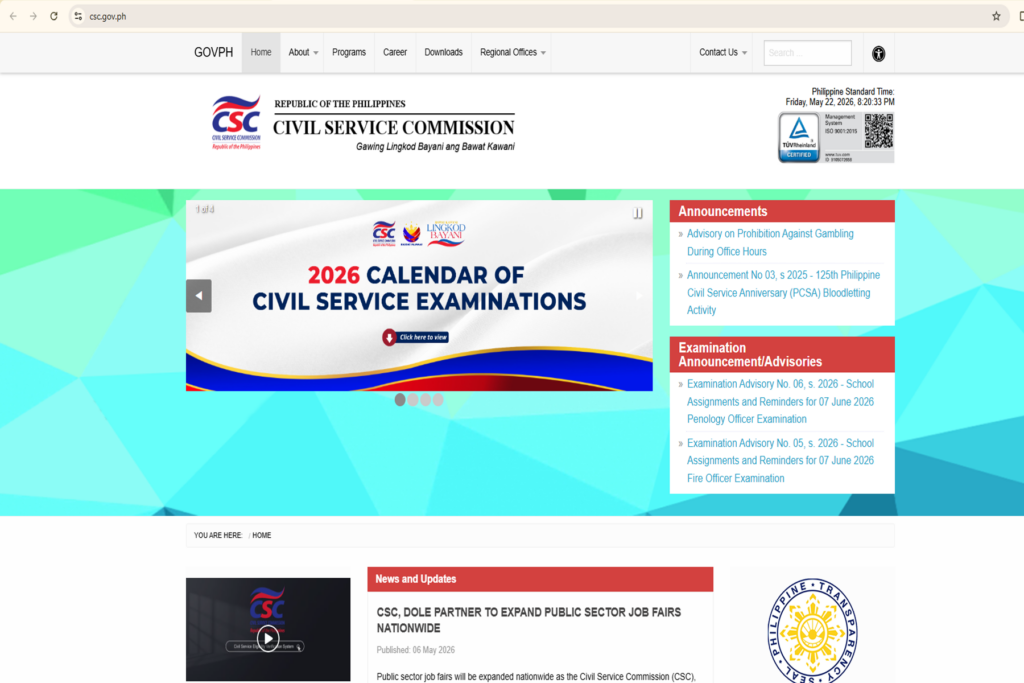
While we research tirelessly to provide the most accurate, up-to-date guide, specific examination dates, OCSAS portal regional URLs, and exact ID photo measurements are subject to change based on official CSC Examination Advisories. To read the exact legal texts regarding civil service rules, you may consult the Official Gazette. For official account registrations, booking slots, or verifying your room assignment, please transact directly through the official CSC portal (csc.gov.ph).
Your Next Steps & Related Master Guides
Passing the Civil Service Exam is your golden ticket to a lifetime career in the Philippine government. While you wait for the exam day, ensure the rest of your government employment portfolio is 100% complete so you are ready to be hired the moment you get your passing rating. Check out our other highly detailed master guides:
- First Time Job Requirements Philippines 2026 (Complete Fresh Graduate Checklist)
- Complete Government ID Requirements Philippines 2026 (The Big 6 Primary IDs)
- NBI Clearance Online Appointment Guide 2026 (Skip the Line)
- TIN ID Online Registration Philippines 2026 (Easy BIR ORUS Guide)
- National ID Requirements Philippines 2026 (Complete PhilSys Guide)