
Complete NBI Clearance Requirements in the Philippines 2026: Fast & Hassle-Free Step-by-Step Guide
If you are applying for a new job, planning to work abroad as an OFW, or putting together your documents for a government ID or visa, understanding the NBI clearance requirements in the Philippines is your absolute first step.
Years ago, getting this document meant waking up at 3:00 AM, falling in line outside a mall or the main UN Avenue branch, and hoping you wouldn’t get cut off by the daily quota. Today, the system has completely changed. The National Bureau of Investigation now enforces a strict online appointment system, and showing up unprepared—or with the wrong documents—will simply result in you being sent home.
Based on our experience guiding over a hundred applicants through the government documentation process, this 2026 pillar guide covers everything you need to know about the NBI clearance requirements in the Philippines. We will walk through the exact valid IDs you need, how to claim your free clearance if you are a first-time job seeker, how to navigate the online portal, and the real truth behind the dreaded “HIT” status.
What Exactly is an NBI Clearance?
Before we look at the specific NBI clearance requirements in the Philippines, it helps to understand what this piece of paper actually does. An NBI Clearance is an official government document proving that you do not have any pending criminal cases or derogatory records filed against you in any court across the entire country.
How is it different from a Police Clearance?
A Police Clearance only checks local records within a specific municipality or city. An NBI Clearance is a national search. It taps into a centralized database that links all regions. This is why employers, foreign embassies, and the Department of Foreign Affairs (DFA) heavily rely on it.
Core NBI Clearance Requirements in the Philippines (What to Bring)
When gathering your NBI clearance requirements in the Philippines, the biggest mistake applicants make is bringing the wrong IDs to their appointment. The NBI personnel at the verification window are very strict. You cannot use a random library card or an expired company ID.
To enter the NBI branch and have your photo and biometrics taken, you must physically bring the following:
- Your NBI Reference Number: This is the number generated after you book your appointment online. You do not need to print the whole form; a screenshot of the reference number on your smartphone is usually fine, though printing it makes the verification process faster.
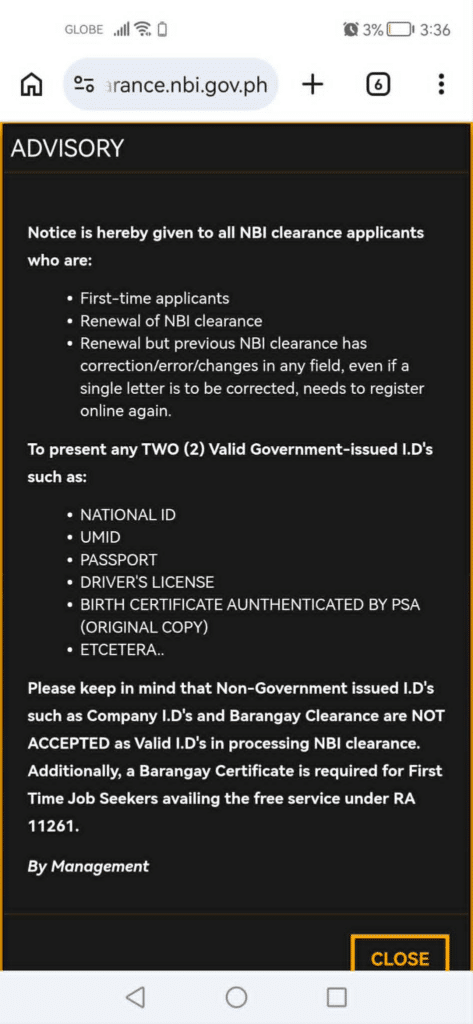
- Two (2) Valid Government-Issued IDs: They must be original (no photocopies) and must clearly show your full name, clear photo, and signature.
- Your Own Pen: You will need to sign a physical logbook or fingerprint card in some branches.
List of Accepted Valid IDs
To successfully fulfill the NBI clearance requirements in the Philippines, you need to present two IDs from this specific government-approved list. If your wallet is empty, refer to our comprehensive guide on the Complete Valid ID Requirements in the Philippines to secure one.
- Philippine Passport
- UMID (Unified Multi-Purpose ID)
- PhilSys ID (National ID – Physical card or ePhilID)
- Driver’s License (Valid)
- PRC ID (Professional Regulation Commission)
- Voter’s ID or Voter’s Certificate with picture
- Postal ID (New plastic card type)
- TIN ID (Must be the new digitized version with photo)
- PhilHealth ID (The PVC card type, not just the cardboard cutout)
- Senior Citizen ID
- PWD ID
- School ID (Only accepted if you are currently a student, accompanied by a current registration form)
Real Applicant Tip: The Birth Certificate Backup
If you only have one valid ID from the list above, bring your Original PSA Birth Certificate. Most NBI branches will accept ONE valid ID plus your PSA record as a complete set of requirements. (If you don’t have one, check out our guide on how to get your PSA Birth Certificate online). Never bring a company ID; they are automatically rejected because they are not government-issued.
How to Get a FREE NBI Clearance (First Time Job Seekers)
If you are a fresh graduate or an out-of-school youth seeking your very first job, compiling your NBI clearance requirements in the Philippines does not have to cost you money. Thanks to Republic Act 11261, also known as the First Time Job Seekers Assistance Act, you can claim this document completely free of charge.
However, you cannot just walk in and say it is your first job. You need to officially prove it. Here are the specific First Time Job Seeker requirements:
- Barangay Certification: You must go to your Barangay Hall and ask for a First Time Job Seeker Certificate. The barangay captain must sign it, confirming that you are a resident and have never been formally employed before.
- Oath of Undertaking: This is a document you sign at the barangay hall promising that you are genuinely using the document to find work.
- Valid ID: Even if the clearance is free, you still need to present a valid ID to prove your identity.
Important Note: You can only avail of this benefit once. The NBI system tracks your name, so you cannot claim a free clearance again next year. You can also use this exact same barangay certificate to process your SSS Requirements Philippines 2026 application for free. Read our full First Time Job Requirements Philippines guide to maximize this law.
The Strict “No Walk-In” Policy
One of the most strictly enforced NBI clearance requirements in the Philippines is the appointment rule: Do not show up at an NBI branch without a confirmed online appointment.
Security guards are instructed to turn away anyone who cannot present a paid reference number. The only exemptions to the “No Walk-in” rule are usually senior citizens, pregnant women, and persons with disabilities (PWDs)—and even then, they must have already registered an account online and generated a reference code.
Step-by-Step Online Registration Walkthrough
To successfully process your NBI clearance requirements in the Philippines, setting up your appointment correctly is vital. Here is how to do it without encountering portal errors.
Step 1: Go to the Official NBI Clearance Portal
Make sure you are on the official government site: clearance.nbi.gov.ph. There are many fake websites online trying to steal personal information. Look for the “.gov.ph” at the end of the URL.
Step 2: Register a New Account
On the right side of the screen, you will see a box asking if you have an old NBI clearance.
- If this is your first time, click “NO”.
- Fill in your gender, civil status, birth date, and complete name.
- Use an active email address and create a password you will not forget. You will need this account for future renewals.
Step 3: Fill Out the Applicant Information Form
Once you are logged in, fill out all the blank fields. This includes your address, family background, and educational attainment.
Warning: Be incredibly careful here. Whatever you type in this form will be printed exactly as-is on your final clearance. If you misspell your own middle name, you will have to pay for a new appointment to fix it.
Step 4: Click “Apply for Clearance”
A window will pop up asking for the Valid ID you intend to present at the branch. Select the ID from the dropdown menu (e.g., Passport) and type in the ID number.
Step 5: Select a Branch and Schedule
Choose an NBI branch that is convenient for you. You do not have to choose the branch in your hometown; you can choose the one closest to your office. After selecting a branch, click on a date and choose either the AM or PM schedule.
Step 6: Choose Your Payment Method
Select how you want to pay. Once you click proceed, the system will generate your Reference Number. Take a screenshot of this.
Fees and Payment Options
Part of completing your NBI clearance requirements in the Philippines involves settling the official fee. The standard multi-purpose clearance fee is ₱130.00. However, depending on your payment method, there is usually an additional system fee or convenience fee of ₱25.00 to ₱30.00.
You can pay using:
- E-Wallets (Most convenient): GCash and Maya. Your payment reflects almost instantly.
- Over the Counter: 7-Eleven, Bayad Center, LBC, and major pawnshops.
- Online Banking: BPI, BDO, UnionBank via the Dragonpay gateway.
Remember: Your appointment is not confirmed until the fee is paid. If you show up at the branch with an unpaid reference number, they will ask you to step aside and pay online before entertaining you.
The Dreaded NBI “HIT” Status Explained
A common issue when submitting your NBI clearance requirements in the Philippines is the “HIT” status. You’ve paid, you’ve lined up, your photo was taken, and you go to the printing window. Instead of handing you your clearance, the staff hands your receipt back with a stamp that says “HIT” and tells you to return after 8 to 15 days.
Panic sets in. Did you do something illegal? Don’t worry. Getting a “HIT” is extremely common. All it means is that the NBI database found a criminal record that shares your name.
Why did I get a HIT?
The Philippines has over 110 million people. If your name is Juan Dela Cruz, Mark Santos, or Maria Reyes, there is a very high probability that someone else in the country shares your exact first and last name.
If the other Mark Santos has a pending case for estafa or reckless imprudence, the computer system automatically flags your application. The NBI personnel cannot clear you on the spot because they need time to manually open the files, check the fingerprints, compare the middle names, and verify that you are not the criminal in question.
What to do if you get a HIT
There is absolutely nothing you can do but wait. You cannot pay a “rush fee” to bypass a HIT. You must return to the exact same branch on the date stamped on your receipt.
When you return:
- If you were just a namesake, they will simply print your clearance and give it to you.
- If the system flagged a legitimate past record of yours (even if the case was dismissed years ago), you will be asked to go to the NBI Quality Control section. You will need to bring an original Court Dismissal Order or a Certificate of Finality to prove the case is closed.
NBI Clearance Renewal Process
Even for renewals, the NBI clearance requirements in the Philippines strictly dictate that clearances are valid for exactly one (1) year from the date of issue. If your clearance expires, you have two options for renewal:
1. NBI Quick Renewal (Door-to-Door Delivery)
If your expired clearance was issued from 2014 to present, and you have no corrections to make to your name or address, you don’t even need to leave your house.
On the NBI portal homepage, click the “NBI Clearance Quick Renewal” button. Type in your old NBI ID number. Pay the fee (which is higher, around ₱330, because it includes nationwide delivery), and the NBI will simply print your clearance using your old photo and biometrics and mail it directly to your home address.
2. Regular Renewal (Walk-in required)
If you need to change your civil status (e.g., you got married and are now using your husband’s surname), you cannot use the Quick Renewal. You must log into your account, update your information, book a new appointment, and visit the branch so they can take a new photo and update your records.
Dress Code and Branch Etiquette
The NBI is a strict government facility. Treat it like a formal office visit. Many applicants get sent home purely because of what they are wearing.
What NOT to wear:
- Sleeveless shirts, sando, or tank tops
- Shorts of any kind (board shorts, denim cut-offs)
- Slippers, flip-flops, or open-toed sandals
- Heavily ripped jeans
Polo shirts, t-shirts, jeans, and sneakers are perfectly fine. Just ensure you look presentable because the photo they take will be printed on your clearance, and it is the exact same document you will hand to your future employer or embassy.
Frequently Asked Questions (FAQs)
Can I change my NBI branch after paying?
Technically, no. The system allocates your payment to the specific branch you selected. However, based on experience, some smaller mall branches will entertain you if you explain your situation, but this is entirely up to the discretion of the branch manager. It is always safer to go to your chosen branch.
What if I miss my appointment date?
You have a 15-day grace period. If you missed your Tuesday appointment, you can go on Wednesday or Thursday within 15 days of your original date without having to pay again. Just expect that priority will be given to the people scheduled for that specific day.
I lost my NBI Clearance. How do I get a new one?
If it is still within the 1-year validity period, you can go back to the branch where you got it and request a reprint. You will just need to pay the exact same fee again. If it is expired, you need to go through the entire renewal process.
⚠ Important Notice & Disclaimer
RequirementsPH is an independent educational platform created to help Filipinos understand and complete complex government document requirements. We provide updated, accurate steps to assist users with applications, renewals, and statutory compliance.
This website is not affiliated with, endorsed by, or officially connected to the National Bureau of Investigation (NBI) or the Department of Justice (DOJ).
For more details on the NBI clearance requirements in the Philippines, to verify official announcements, or to book your appointment securely, please transact solely through the official government portal: https://clearance.nbi.gov.ph.
About the Author & Research Team
The RequirementsPH Editorial Team is dedicated to simplifying complex Philippine government processes. By combining official data with real-world application experiences, we provide easy-to-follow, actionable guides for every Filipino preparing for employment and travel.